Felicity and I are deeply grateful for Professor Michael van Manen’s seminar yesterday. Prior organisation was a little stilted by email, and the announcement somewhat belated. Nevertheless, we were encouraged by the turnout, a respectful group of almost 50 tuned in. Michael gracefully took us through an illustrated tour of phenomenology of practice, with reference to the ‘Classic Writings’ book and his own research related to his work as a neonatologist.
Professor van Manen presenting
Michael kindly allowed us to record the presentation although his use of many evocative images makes it impossible to share very widely. If you would like to view, please get in touch with us using the info@hanfod.NL email address.
Here are references shared in the seminar:
Networked Learning Editorial Collective (NLEC) et al. 2021. Networked Learning in 2021: A Community Definition. Postdigital Science and Education 3(2), pp. 326–369. doi: 10.1007/s42438-021-00222-y.
van Manen, Max 2016. Researching lived experience: human science for an action sensitive pedagogy. Second Edition. London New York: Routledge, Taylor & Francis Group.
van Manen, Michael 2012. Carrying: Parental Experience of the Hospital Transfer of Their Baby. Qualitative Health Research 22(2), pp. 199–211. doi: 10.1177/1049732311420447.
van Manen, Michael 2018. Phenomenology of the Newborn: Life from Womb to World. 1st edition. New York: Routledge.
I stopped recording at the start of the question/discussion part to help everyone feel less inhibited. I have anonymised and reproduced the four questions and answers here though:
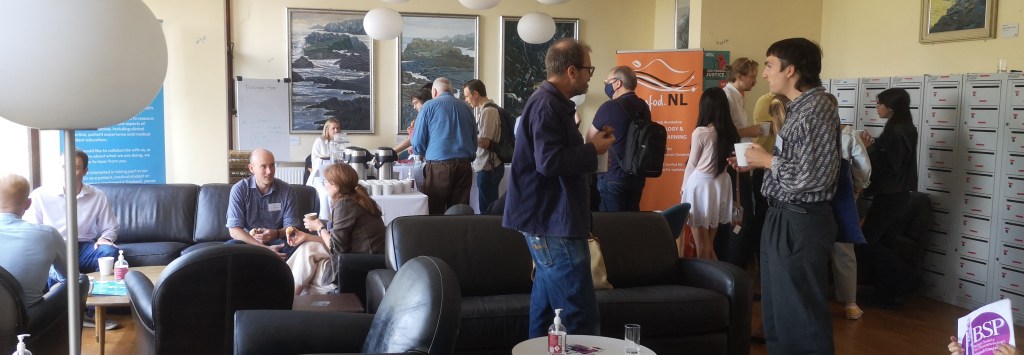
The Senior Common Room at Exeter Queens Building where the hanfod.NL banner had its 2nd outing
Congratulations to the teams (BSP & Exeter) on a brilliant event! It was a great privilege and pleasure to attend in-person after sampling online in 2020. I was a bit embarrassed to be thanked for chairing the methods session yesterday, when the hosts were all over it. I merely did a bit of sentence strangling, to allow a couple more questioners their say. Even that was made far easier by Zoe Waters who anchored the session.
Exeter Quay
I went to Exeter with few expectations but a fair bit of dread, and kept reminding myself of why I was going: literally fly the flag for hanfod.NL But fainter hopes were more than realised. It was so helpful to be exposed to a range of current scholars deploying a wide breadth of phenomenological ideas in a variety of ways. There were certainly opportunities to break the brain on thoroughgoing philosophy but also a range of ‘engaged’ papers. Even the read-out and zoom-streamed philosophy papers were more accessible at a conference. In her NLC2020 keynote, Prof Lesley Gourlay (sadly not at BSPAC2022 – one day Lesley 😉 raised the eventedness of lectures as special, and, if we aim for everything to be recorded, because we can, we risk consigning the arguably richer embodied congeniality of events to channel conducive, generative scholarly activity. At Cardiff’s graduation events, I missed the ceremonial announcement that we were ‘having a congregation’. When we concur to devote time and space of our short lives in these ways, it matters and the in-between chatter matters. In one conversation we reflected on how the pressure to raise production values messes with the messiness of exploring ideas, plainly admitting we do not have all the answers cuts against demands to be slick.
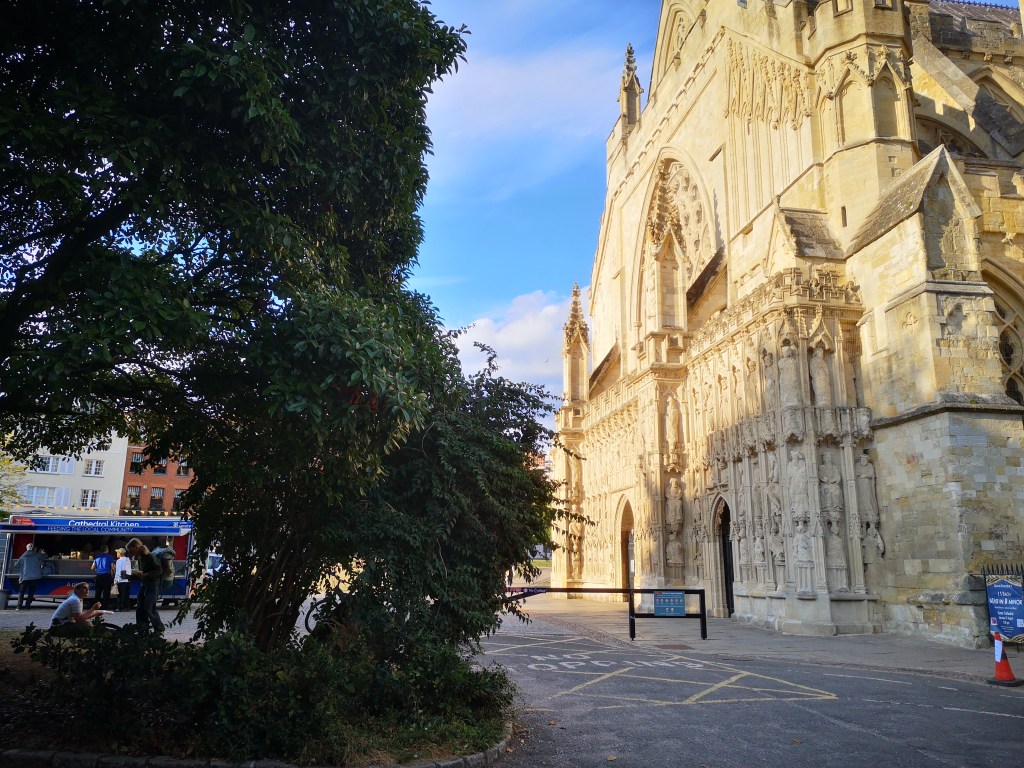
Exeter Cathedral in the sun, community café in shade
I don’t claim much depth to my phenomenology yet I was able to keep pace with many of the papers. Without mentioning names, someone in the methods session criticised the inherent reductivism in published frameworks that aim to help novice phenomenologists. Of course, such frameworks can be helpful, and this is especially the case where a ‘loose coupling’ leaves the researcher with guiding stars, rather than a prescriptive routine that squeezes out opportunities for developing reflexivity. Students can be in too much of a rush and instrumentalise the method instead of understanding it and their place in it. Phenomenology is beyond understanding for the best of us anyway… And yet, Max van Manen’s phenomenology of practice, not mentioned this week, does, for me, hit a sweet spot of impelling one to push for deeper grounding into the heart of phenomenology while laying out the parts in sufficient detail to avoid getting completely lost. Max was busy on a new edition of his 2014 book, so we were thrilled that his son, Michael van Manen, who did get a mention this week, agreed to present for us on the 14th (see previous blog post). I was not there to present a paper, at least I was able to encourage a few scholars even newer to phenomenology than I am: I was able to point to the place of oft dreaded canonical writers, drawing from Max van Manen’s framing them as ‘insight cultivators’. It’s not how much you cover, but how inspiring a sentence can be for analysis. With that in mind, I’ve set off on a 2-page per day odyssey with Merleau-Ponty’s Phenomenology of Perception. I’ve always believed in the importance of reading beyond oneself but MP seems harder than Gadamer! I will find my feet again in the Preface, which is more than enough to stretch the mind.
Statue of Floella Benjamin, famed Chancellor (not least for hugging graduating students rather than doffing or handshaking!
Back to the conference, another draw for me, and hanfod.NL interests, was that Dr Lucy Osler was presenting. One of her aims was to seek another way out of the dichotomy between technological optimism/pessimism and online/in-person sociality. A brilliant talk, there were clear links with the recent symposium papers and great potential for cultivation of insight!
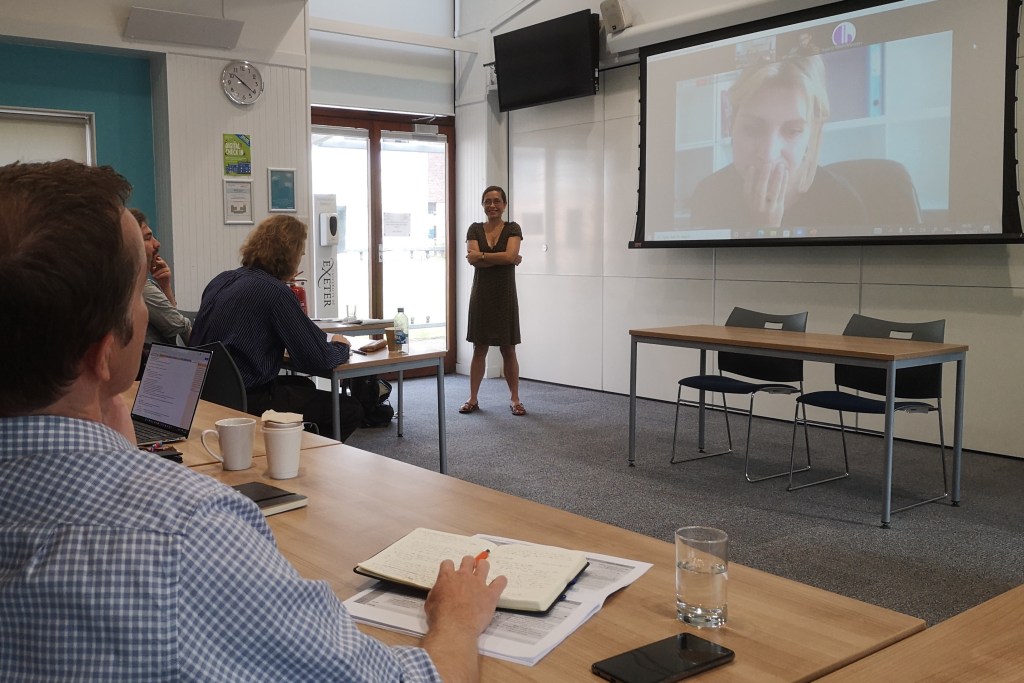
Lucy Osler beaming in from Copenhagen on the first day of her lectureship at Cardiff! Just outside is the well greased elbow of Matt Barnard, indefatigable in his support of the event – big thanks to him!



 hanfod.NL