Call for Papers for the 14th International Conference on Networked Learning in Higher Education, Lifelong Learning and Professional Development, Malta

To our friends of hanfod.NL, following our exciting engagement at the 13th conference in Sweden in May 2022 we are thrilled to share the Call for Papers for the 14th International Conference on Networked Learning in Higher Education, Lifelong Learning and Professional Development.

The overarching theme of the conference is “Networked Learning as a pedagogy of hope” and some of the key themes are:

  • Digital futures and environmental renaissance
  • Artificial intelligence, learning analytics and emergent digital technologies
  • Ethical and responsible innovation and research

The conference is hosted by the University of Malta, at the Valletta Campus in Malta, on May 15-17, 2024.

Keynote Speakers:

  • Jen Ross – University of Edinburgh, Scotland
  • Alexei Dingli – University of Malta, Malta
  • Felicitas Macgilchrist – University of Goettingen, Germany

Key Dates:

  • Full/short papers or symposia proposals must be submitted by 6th October, 2023
  • Workshops/Round tables must be submitted by 17th November, 2023
  • Notification of acceptance by 15th December, 2023

All submissions are peer reviewed, and accepted submissions are published in the conference proceedings. Selected papers are invited for publication in an edited book as part of the Springer book series “Research in Networked Learning”. 

Full conference details can be found at:  https://www.networkedlearning.aau.dk/nlc-2024 

To receive updates from the Networked Learning Consortium – sign up for the newsletter: https://www.networkedlearning.aau.dk/news

We will be there and encourage you to join this vibrant community of scholars, educators, and innovators.

Mark your calendars for May 15-17, 2024 for this exciting event at the picturesque Valletta Campus. Don’t miss this opportunity to connect, learn, and inspire at a conference that embraces the pedagogy of hope.

Felicity and Mike.


Scholarship, and wonder

With an eye to Gadamer’s elaboration of Bildung (in Truth and Method), I wrote the following response to a call for members of my immediate academic community to define scholarship. Many have already made excellent points about pedagogic research, etc., through a collaborative padlet. For example, citing the work of Minocha and Collins (2023), Impact of Scholarship of Teaching and Learning: A guide for educators. The Open University, Milton Keynes, UK. DOI: https://doi.org/10.21954/ou.ro.000155c1

I felt something was missing:

One of the problems with HE is the sense that time and effort must be maximally instrumentalised, ‘for profit’, ‘to increase productivity/effectiveness’, and pedagogic research may be a case in point… But scholarship has an element of obliging one-self in self-cultivating, keeping oneself open to what is ‘other’, towards an ideal that owns ‘no goals outside itself’; it is no mere means to an end. This implies a strong place for theory, and especially that which is discomforting, even alienating, beyond the immediate and familiar. 
For this, the scholar must enjoy a state of unhurried psychological safety. Until the university patently prizes its scholars’ time, for too many this will remain an irritating pipe-dream glanced at from the treadmill. 

I felt there is a resemblance here to the phenomenological reduction which requires an opening of the self to wonder, as when confronted with the majesty of creation (pic from a recent trip to Cadair Idris). Without this move, can we escape the circular self.

Double sunset over Barmouth from Cadair Idris, by Mike

Seminar 5th July 1-2pm with Dr Kyungmee Lee

Before leaving for Seoul, Kyungmee is visiting us in Wales and we’re delighted to link her up with Cardiff University’s School of Social Sciences Educational Research Seminar Series. We’re meeting in-person at the Glamorgan Building Council Chamber and online through Zoom (joining link). There’s no need to register if you wish to join.

The title of her talk will be ‘Educational Researcher (and Machine) in the Posthuman Era: Methodological Reflections.

There has been increasing enthusiasm for and conversation on machine-assisted research innovation in the broad field of education and social sciences. This seminar will provide a brief overview of popular claims—both positive and negative—about fast-emerging posthuman conditions; and unpack some of the dominant discourses of innovative machine-assisted research approaches. The ‘back-to-person’ and ‘back-to-basic’ methodological approaches, exemplified by autoethnography and evocative academic writing, will be discussed as a critical alternative approach to rethinking machine-assisted research and researchers.

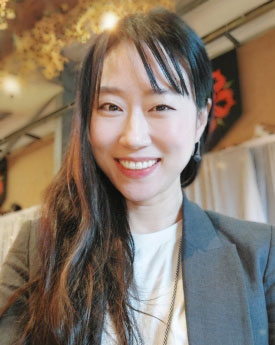
Who is Kyungmee??

Senior Lecturer in the Department of Educational Research at Lancaster University. Kyungmee is a co-editor of Studies in Technology Enhanced Learning. Her research targets the intersection of online education, adult education, and international education concerning issues of accessibility and inclusivity. Using a range of qualitative research methodologies and evocative academic writings, her current projects investigate the academic experiences of diverse non-traditional student groups in distance education settings. Kyungmee’s scholarship emphasises concepts of discourse, knowledge and power, understood through a broadly Foucauldian lens.

Book agreed

Just over a year after our ‘found chord’ double-symposium at NLC2022*, we were thrilled to hear today that our book proposal has been approved to take a place in the formidable Networked Learning Springer book series. Our proposal takes in updated versions of the symposium papers and weighty additional original chapters from Norm Friesen, Stig Borsen Hansen and Lucy Osler.

So, today, our vision for advancing phenomenology in networked learning took a big step forwards. It was so encouraging to read our proposal reviewers’ comments. This is the fruit of tremendous effort and commitment by the author/editorial team, some of whom have faced up against life’s severest head-winds. I feel a great sense of gratitude to chapter and book reviewers who have taken such a positive and constructive approach, all but guaranteeing that the finished product will be greatly enhanced. Of course, good feedback entails yet more work to realise that potential!

*The symposium papers are available now collated within the NLC22 proceedings available on the NLC website (pages 423-482).