

We try and avoid hyperbole, but Dr Kyungmee’s next job seems really amazing. At the end of the month, she’s relocating from Lancaster’s CTEL, to join the Department of Education at Seoul National University, South Korea as Associate Professor in Qualitative Research Methodology. Her task: bring qualitative research to South Korea, where a very high proportion of research outputs are quantitative.
Kyungmee was keen to visit us in Wales for a number of reasons, apart from simply sharing the same time and space to discuss ideas in-person, which was a wonderful privilege. Kyungmee is contributing a chapter to our book, and I’ve known her since 2014 when I started the CTEL doctoral programme. Since then we’ve also popped up at the Networked Learning Conferences together, and hopefully we’ll meet again in Malta for NLC there next year. Hope you can join us!
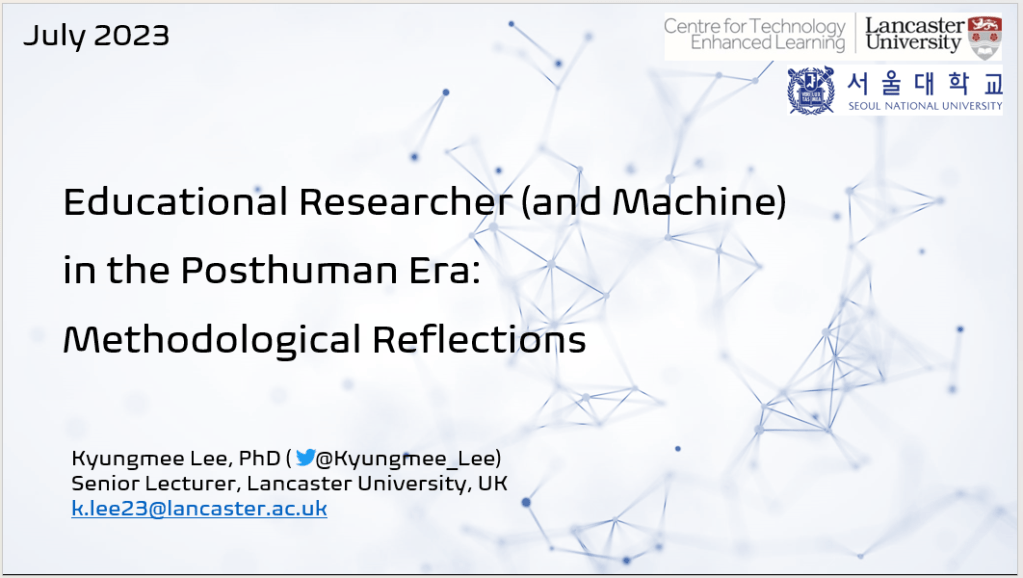
Yesterday, for an hour in the Glamorgan Council Chamber, we piggy-backed onto Cardiff University School of Social Sciences’ education research seminar series for 2022-23, with a session exploring the claims/discourses around Artificial Intelligence with respect to qualitative research. Kyungmee noticed that AI does not ‘struggle’, indeed that is a selling point, where AI promises to alleviate struggle and help us achieve ‘better research findings’ in a ‘smarter’ way and outputs that we can have greater confidence in. This can be seen in marketing for recent AI enhancements to ATLAS.ti, a popular qualitative data analysis platform. But are AI shortcuts legitimate to authentically develop deep insights into human experiences, such as those featured in a recent ‘Autoethnography’ special issue of Studies in Technology Enhanced Learning, where authors are concerned with workplace bullying, discrimination, institutional racism…?? AI discourses play into dominant wider (meta-)discourses of an ‘economic-pragmatic nature, that demands fast, efficient, predictable and controllable productivity from the educational institutions.” (Hodgson et al. 2012, p300, drawing upon Levinson & Nielsen’s use of Dyson, 1999). This is at least a paradox when also considering educational trajectories that cherish students’ development towards autonomous and collaborative criticality and creativity. In our post-digital era, student and researcher already faced an existential threat from information over-production, a seemingly ever-growing barrier to enter and stay abreast of almost any field. AI solutions to the processes of literature reviewing seem benign, and even helpful. But the discourses around AI invite us to distrust humans: ‘Data has a better idea’. This runs counter to ground that qualitative researchers had presumed they occupied. As De Silva and El-Ayoubi (2023) indicate, all aspects of human science question ideation, method selection, data analysis, writing up and review, could be outsourced to software. Neoliberal higher education is sucking us dry with imperatives to do more with less: churn high-ranking impactful outputs under conditions of diminishing salaries, career uncertainty and over-work. We’re tired. Even while writing this, WordPress is suggesting that AI can make up for my humanity – how ironically demeaning.

Nevertheless, Kyungmee said, qualitative researchers contend that, “humans are political beings in unique historical contexts, with our own struggles, perspectives, experiences, and narratives that are subjective and partial.” We must continue to expose social inequalities, the lived experiences of struggle, power relationships/conflicts in people’s complex and nuanced ordinary everyday human life. In the face of Big Data and AI, autoethnography sails in the opposite direction. Indeed, the graft of writing is so bound up in autoethnography and phenomenology it is hard to see a place for AI, unless we meant Authentic Intelligence.

References
De Silva, D. and El-Ayoubi, M. 2023. Three ways to leverage ChatGPT and other generative AI in research. Times Higher Education. 20 June. Available at: https://www.timeshighereducation.com/campus/three-ways-leverage-chatgpt-and-other-generative-ai-research [Accessed: 6 July 2023].
Dyson, A. 1999. Inclusion and inclusions: theories and discourses in inclusive education. In: Daniels, H. and Garner, P. eds. World yearbook of education. 1999: Inclusive education. London: Kogan Page, pp. 36–53.
Hodgson, V., McConnell, D., & Dirckinck-Holmfeld, L. (2012). The Theory, Practice and Pedagogy of Networked Learning. In L. Dirckinck-Holmfeld, V. Hodgson, & D. McConnell (Eds.), Exploring the Theory, Pedagogy and Practice of Networked Learning (pp. 291–305). Springer New York.
Levinsen, K. T., & Nielsen, J. (2012). Innovating Design for Learning in the Networked Society. In L. Dirckinck-Holmfeld, V. Hodgson, & D. McConnell (Eds.), Exploring the Theory, Pedagogy and Practice of Networked Learning (pp. 237–256). Springer New York.

 hanfod.NL