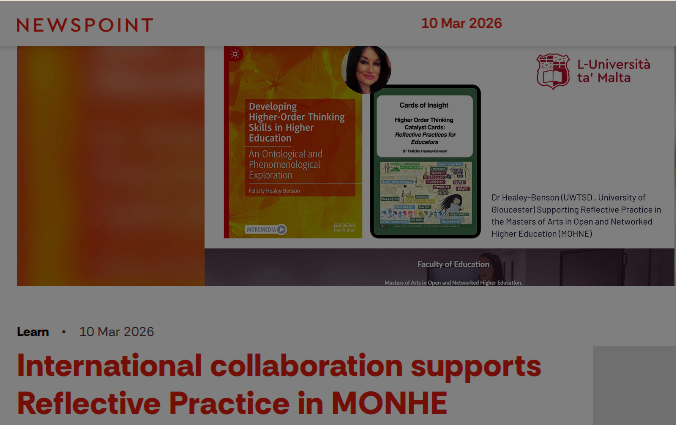
A recent media byte from the University of Malta describes how the Masters in Open and Networked Higher Education (MONHE) programme is integrating Felicity’s Cards of Insight framework into the study-unit Reflective Practices (ACA5062). The framework emerges from her hermeneutic phenomenological research into higher-order thinking in higher education and is being used within the programme to support dialogical, practice-based reflection at Masters level.
This marks the second collaboration between MONHE and Felicity. Earlier engagement with a previous cohort informed the reflective chapter in her recent monograph Developing Higher-Order Thinking Skills in Higher Education: An Ontological and Phenomenological Exploration (Palgrave Macmillan, 2026). Unlike conventional reflective toolkits that rely on procedural models or checklist evaluation, the Cards of Insight operate as dialogical provocations. Structured across interconnected thematic subsets, they invite educators to dwell with tensions, relational nuance, and professional positioning within their practice.
It was such a joy to meet up yesterday – with Dr Lucy Osler, Cardiff University philosophy and, in spite of many toils and trials, Dr Felicity Healey-Benson, in triumph following recent viva success!! Warmest congratulations to Felicity!!
Lucy joined Cardiff last summer from completing a post doc at the Center for Subjectivity Research at the University of Copenhagen, run by Dan Zahavi, attached to a project run by Thomas Szanto. We are thrilled that Lucy has agreed to provide an opening chapter for our collaboration, ‘Phenomenological Perspectives on Networked Learning’. Lucy aims to explain what philosophical phenomenology offers the field of networked learning and, since NL is a new field for her, we spent some time discussing its definition and distinctives. I am thrilled that Lucy is keen to help. Phenomenology has been a contested space, and many point to it as key to their research. There are all shades of claims made to verify a project’s phenomenological credentials, with anything from a brief mention of Husserl, to more elaborate frameworks. With our book, we aim to portray some of this diversity, disavowing sectarianism, but Lucy’s chapter should set us out with a voice from the same philosophical river of which Heidegger spoke.
I was happy to lend Lucy my copy of Chris Jones’ (2015) book and observed that many scholars coming afresh to NL struggle with the term, and even feel the need to seriously challenge it. I find it helpful to refer to Peter Goodyear’s blog post where he explains that, originally, networked learning was not ‘our’ choice, but that of a UK funding body:
In the circumstances – late 1990s, UK Higher Education – it was quite likely that Jisc would fund proposals that focussed only on individual use of online learning materials (given the interest in personalised learning and more efficient “delivery” of education). We were keen to create other opportunities: a more ambitious conception of what was possible and worthwhile. We weren’t introducing the term “Networked Learning” – we were expanding what it meant and beginning to shift the core of its meaning.
Thus, arguably more central to whatever else we mean by networked learning these days is the keenly felt need to contend for education along ‘critical and emancipatory’ lines. Although the newer NL definition takes a post-digital approach by presuming ICT, rather than explicitly mentioning it, I tend to agree with Chris Jones who still (see NLEC et al. 2021) holds out for the importance of explicitly circumscribing the definition with information technology because otherwise NL is in danger of becoming a ‘theory of everything’, and, quite possibly, nothing of very much analytical purchase, or saying much more than good old humanism… which was how it felt at the SHRE ‘relational pedagogies’ book launch on Tuesday, surely ‘connections’ that NL scholars have been ‘promoting’ for decades. Yet we all need to keep an eye on Hannah Sfard’s wisdom, ‘On Two Metaphors for Learning and the Dangers of Choosing Just One.’
Jones, C.R. 2015. Networked learning : an educational paradigm for the age of digital networks. London: Springer.
Networked Learning Editorial Collective (NLEC) et al. 2021. Networked Learning in 2021: A Community Definition. Postdigital Science and Education 3(2), pp. 326–369. doi: 10.1007/s42438-021-00222-y.
Osler, L. and Zahavi, D. 2022. Sociality and Embodiment: Online Communication During and After Covid-19. Foundations of Science . Available at: https://doi.org/10.1007/s10699-022-09861-1 [Accessed: 3 October 2022].
Sfard, A. (1998). On Two Metaphors for Learning and the Dangers of Choosing Just One. Educational Researcher, 27(2), 4. https://doi.org/10.2307/1176193
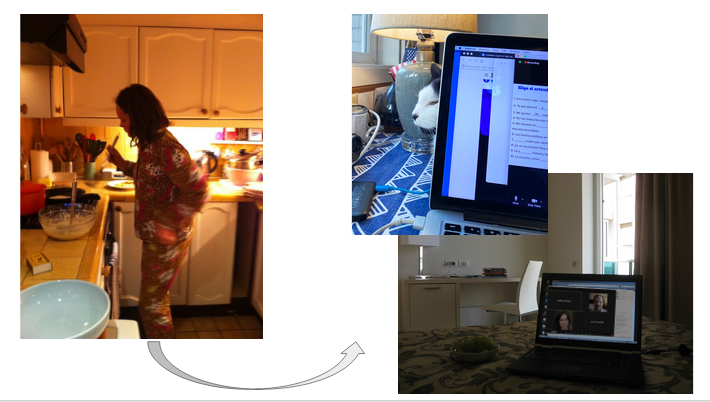
Wonderfully, some of us are able to travel to an international conference to celebrate and enjoy this event, after an in-person hiatus of four years for regular NLC delegates. I am writing this as the coach takes me from Wales across England to Heathrow. Very sadly I am mindful that Professor Cathy Adams is unable to attend for unavoidable personal reasons. Her in-person presence will be sorely missed and we wish her well (hugs will be all the tighter next time, DV). This throws down the baton for Felicity and myself to make a success of the workshop on Tuesday afternoon, based heavily upon Cathy’s content and approach. For this 90-minute workshop, we are running in-person only (but offering another online only workshop 12 & 14 September 14.00-17.30 (UK time). The organisers sensibly opted for a hybrid of online and in-person attendance. Whatever the merits and compromises of trying to cater for both, the prospect of having to swing to online only again was very real and we would just have to make it work again. Life has become even more uncertain over the last months, and these very days, our conference host nation is deciding whether it will join NATO, something Russia may not take without disruptive retaliation… something every one of us travelling to Sweden has a heightened awareness of. Why travel when you could ‘videoconference’ is an obvious question that some will ask. Below are two slides from our zoom breakout room presentation to help explain. When I played spot-the-difference with these images with students yesterday, although there were smirks at those in the picture who were slumbering (a classic trope used by those who denounce lectures), their other responses chimed with Prof Lesley Gourley’s superb keynote at NLC2020, and the eventedness of this kind of gathering that was so much richer than what is sometimes mocked as an embarrassing attempt at anachronistic, domesticating knowledge transfer into passive recipient digital natives with hybrid learning styles and minimal attention spans.
In-person education (large class to group-working)Online education (large class to group-working)
A single daisy for our first recording in the daisy chain series – image CC Kelbv
To herald the Networked Learning Conference in May, we aim to release short audio reflections, linking with our symposium, and possibly each other’s recordings. Practically, we have in mind those who are curious about exploring networked learning and phenomenology, with the hope of inspiring more people to join in. However, part of the reason is that we just can’t keep quiet for long! – it must be admitted that there is an element of self-indulgent enthusiasm behind this mini-project 🌞
We love metaphors: daisy-chains are delicate, free, and carry a universal, humble beauty. They are often made in a shared between-time, and bestowed as a happy love gift in-person. We hope for you it is the thought that counts. When, as in the COVID-19 pandemic, mitsein (being-with, after Heidegger) may be in short supply, it behoves us, as we can, to humanise interactions and mitigate alienation. We hope hearing our voices will help you to connect more richly with us and the ideas we present. The voice alone is not video, but, as McLuhanesque hot media, may be all the more intriguing for that.
We are beyond delighted that Dr Greta Goetz, University of Belgrade, agreed to start us off. As one might expect, given her 2021 PDSE article, the recording is a singular work of scholarship in its own right, weaving many redolent ideas from her deep engagement with phenomenology. Mike (2008, p330) has styled information technology as ‘a chain of weak links’, which is also a feature of daisy chains, so we invite you to take advantage of the recording while it, the transcript and references, are still available. Honouring Greta’s authorship, the 11 minute recording is to be found on Greta’s site using this link.
References
Goetz, G. (2021). The Odyssey of Pedagogies of Technoscientific Literacies. Postdigital Science and Education, 3(2), 520–545. https://doi.org/10.1007/s42438-020-00188-3
Johnson, M. R. (2008). Investigating & encouraging student nurses’ ICT engagement. In T. T. Kidd & I. Chen (Eds.), Social Information Technology: Connecting Society and Cultural Issues (pp. 313–335). Information Science Reference.
McLuhan, M. (2001). Understanding media: The extensions of man. Routledge.
It was a high delight even to meet virtually last Monday, 1st November, to align our objectives and aspirations for a phenomenology and networked learning symposium at the next conference 16-18 May 2022. Felicity and Mike are gently pinching ourselves – we feel like we have a ‘dream team’ of enthusiastic participants who can genuinely carry the hanfod.NL vision of bringing phenomenology into the spotlight within networked learning.
Greta Goertz (2021 PDSE article) – Re-presencing the digital trace in networked learning design
Nina Bonderup Dohn – to discuss Merleu-Ponty’s importance for networked learning research (YouTube video abstract)
Kyungmee Lee (Twitter profile) – exploring what phenomenological ideas can bring to writing ‘thick description’
Felicity, Mike, Cathy Adams and Joni Turville (Twitter profile) bring a phenomenology of practice lens to the student’s experience of Zoom breakout rooms.
Some of the discussion was about having five solid full papers when a symposium is usually four papers, but we have ambitions around filling a double-symposium and developing something substantial to make good use of the time.
We established a few dates: Mike to draft a symposium proposal outline by 26th Nov. 10th Dec to send around full drafts of papers to each other for feedback and responses, and comment on the symposium draft. 3rd Jan 2021 for final full papers, ready for submission as soon as possibly prior to the 7th January target for Networked Learning Conference scientific review.
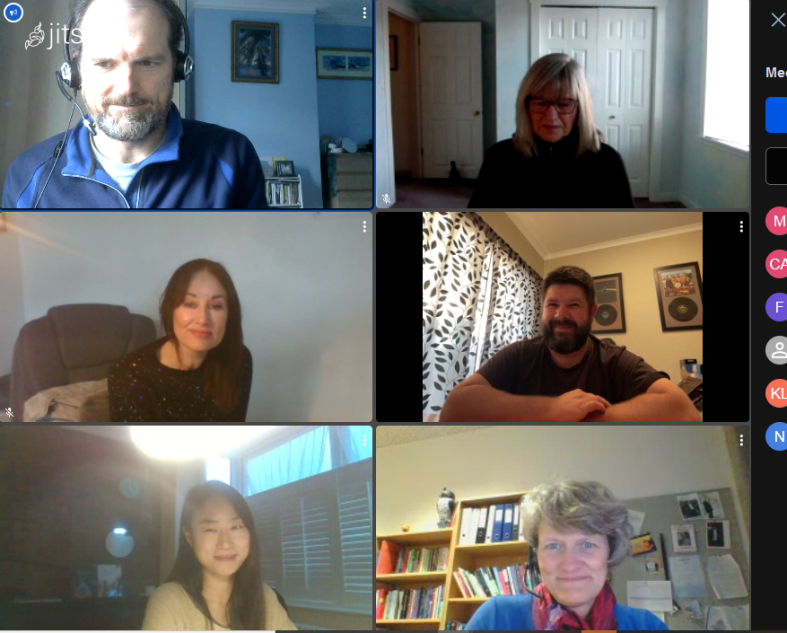
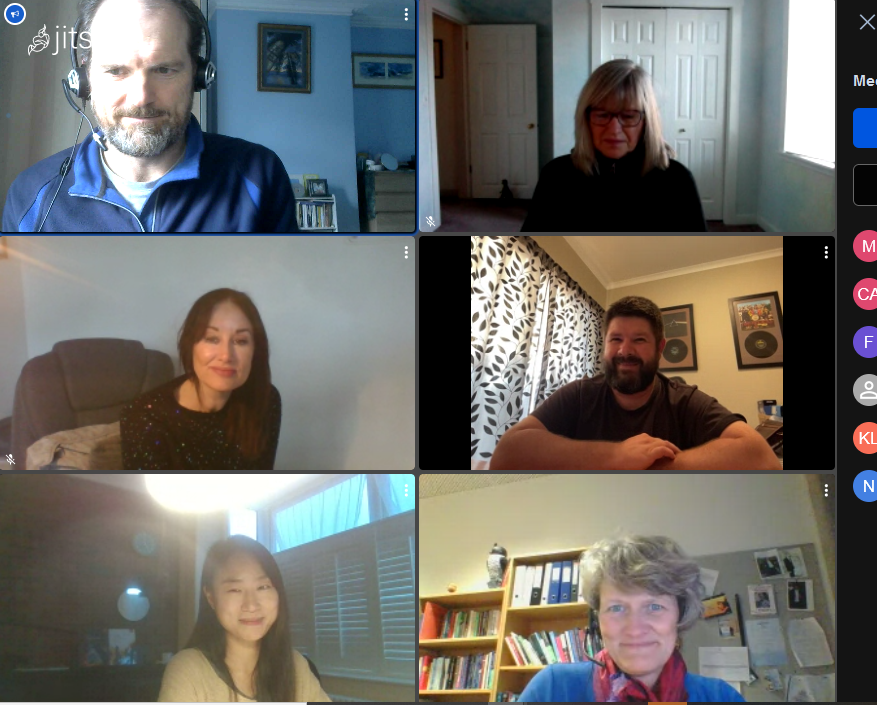
In sympathy with Greta’s idea of retaining control of the traces we leave within the Internet, we chose to use Jitsi for this meeting and it performed admirably although browser-based (sometimes app-based video-conference tools are more stable). Unfortunately Greta was delayed and so unable to join the group photo-call.





 hanfod.NL