Felicity’s book, Mike’s (free) seminar

With higher education’s funding in a mess, Felicity and I continue giving ‘side of the desk’ attention to hanfod.NL (i.e., for free) but now without the supporting infrastructure of an academic post. Nevertheless, we’re still committed to the field, and the ground we broke up for ourselves:

Reflecting in Aristotle’s Gymnasium

Reflections on Phenomenology in Action: Our Roundtable Experience


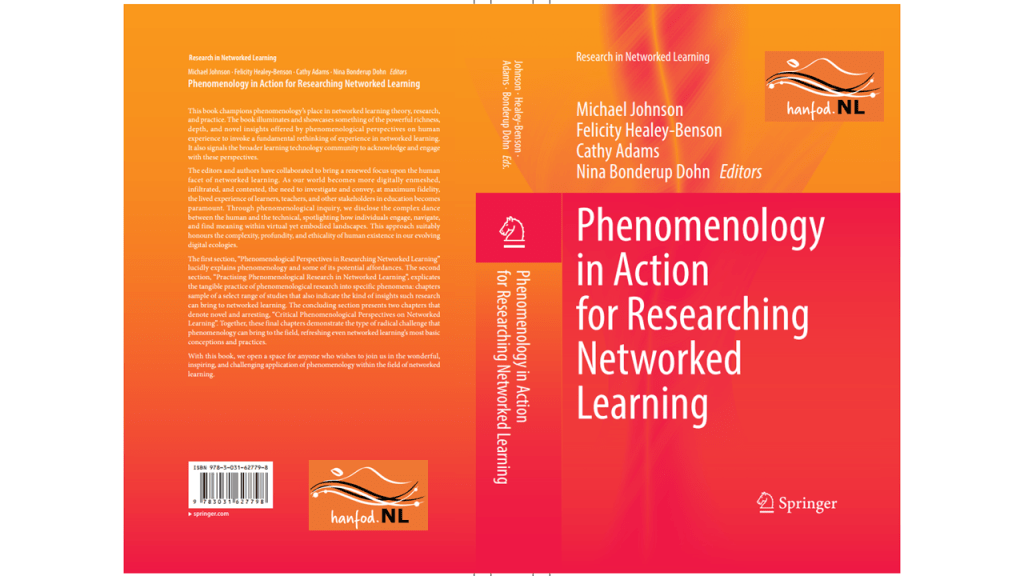
The recent roundtable discussion on our forthcoming Springer book Phenomenology in Action for Researching Networked Learning at the 14th International Networked Learning Conference hosted by the University of Malta was an enriching experience. As editors and authors, Mike, Cathy, Nina, and I were humbled by the thoughtful perspectives and valuable insights shared by our esteemed roundtable discussants.

Dr Maria Cutajar of the University of Malta began with comments that underscored the depth and rigour demanded by phenomenological inquiry, while also acknowledging its transformative potential. She emphasised the book’s invitation to think more deeply about our experiences as humans in an increasingly digital world.

Professor Mark Vagle, dialling in from Minnesota, appreciated the book’s nuanced engagement with different phenomenological approaches, highlighting its recognition of phenomenology as plural. He commended the framing questions that guided each section, drawing attention to the emphasis on what phenomenological investigations can reveal and how phenomenology can challenge networked learning.

Professor Lesley Gourlay’s reflections resonated deeply. She spoke about the importance of slowness, stillness, and attending to the ineffable aspects of experience – qualities that phenomenology can help surface. Lesley highlighted the book’s potential to push back against the transhumanist ethos and open up new ways of understanding lived experiences in educational contexts.

Professor Emeritus Vivien Hodgson, a pioneering figure in networked learning, raised thought-provoking questions about the relationship between phenomenology and autoethnography, and the possibilities of integrating creative non-fiction writing techniques. Her insights shed light on how phenomenological approaches could enable richer, more empathetic understandings of lived experiences.

The discussants’ reflections reinforced our belief in the value of phenomenological perspectives for researching networked learning. Their insights have further inspired us to continue exploring the roles, possibilities, and challenges of using phenomenology to understand the complexities of human experiences in digital learning environments.

We are grateful for the engaging discussion and the opportunity to share our work with the networked learning community in Malta. We were also very excited to have some of our contributing authors join us in person – Associate Professor Kyungmee Lee, Seoul National University and Professor Greta Goetz, Belgrade University.

As we move forward, we hope this book will serve as a catalyst for more phenomenological inquiries, deepening our understanding of the lived experiences that shape and are shaped by networked learning practices. We now look forward to the official publication month this year, and to communicate our online event to celebrate with you and our full complement of book contributors. We hope also to share with the Postdigital Science and Education Journal, facilitated by Professor Petar Jandric, Zagreb University.

Felicity, on behalf of Dr Mike Johnson, Professor Cathy Adams, & Professor Nina Bonderup Dohn.


Maria Cutajar PhD is a Senior Lecturer in Arts, Open Communities and Adult Education at the University of Malta.

Mark D. Vagle PhD is a Professor at the University of Minnesota, USA. He has written extensively on phenomenological research in journals such as Qualitative Inquiry

Lesley Gourlay PhD is a Professor of Education, University College London.

Vivien Hodgson PhD is an Emeritus Professor of Networked Management Learning at Lancaster University Management School.

Excitement is brewing at hanfod.NL for a dynamic May!

Kicking Off with a Phenomenology Workshop in Cardiff
hanfod.NL is buzzing with excitement as we gear up for an exhilarating May, starting with our fully booked special event at our Cardiff University location. On the 10th of May, we’re delighted to host Professor Cathy Adams, our esteemed Phenomenologist in Residence, for a half-day workshop on Phenomenology of Practice. This event promises to be an insightful gathering, welcoming scores of participants eager to delve into the depths of phenomenological research.

Crossing Over to Malta for NLC24
Our journey continues as we cross the sea to the sunny shores of Malta for the Networked Learning Conference 2024 (NLC24), 15-17 May. We’re so eager to dive into the conference’s rich themes, including digital futures, environmental sustainability, the transformative impact of AI and emerging technologies, and the vital need for ethical innovation education, as well as pick up on our phenomenological notes. This year’s event is set to challenge our current understandings and inspire new perspectives in the realms of networked learning and digital integration.

Distinguished Keynote Speakers at NLC24
Known for her critical and ethnographic approaches, Professor Felicitas Macgilchrist will explore the cultural politics of educational technology, with a focus on critical, ethnographic, and speculative approaches to the educational landscape, Professor Alexiei Dingli of the University of Malta will address the profound impacts of artificial intelligence in educational settings, and Dr. Jen Ross, co-director of the Centre for Research in Digital Education at the University of Edinburgh, will share insights into the future of digital education.

Interactive Roundtable Discussion
Our own Nina, Cathy, Mike, and I are thrilled to be running an interactive roundtable that introduces our forthcoming ‘Phenomenology in Action for Researching Networked Learning Experiences’ edited collection, an addition to the Springer Book Series on Research in Networked Learning in 2024. We eagerly anticipate engaging with our esteemed discussants, meeting up with many of the book’s contributing authors, and furthering our phenomenological discussions.

A Week of Engaging Academic Exchange:
Throughout the week, the hanfod.NL team will be presenting our own papers. Yet this gathering is more than presentations and formal discussions; it’s a wonderful opportunity to connect, feed, and foster relationships while welcoming new voices into our lively community.

May we see you there and/or look forward to share!

Felicity and Mike

Call for Papers for the 14th International Conference on Networked Learning in Higher Education, Lifelong Learning and Professional Development, Malta

To our friends of hanfod.NL, following our exciting engagement at the 13th conference in Sweden in May 2022 we are thrilled to share the Call for Papers for the 14th International Conference on Networked Learning in Higher Education, Lifelong Learning and Professional Development.

The overarching theme of the conference is “Networked Learning as a pedagogy of hope” and some of the key themes are:

  • Digital futures and environmental renaissance
  • Artificial intelligence, learning analytics and emergent digital technologies
  • Ethical and responsible innovation and research

The conference is hosted by the University of Malta, at the Valletta Campus in Malta, on May 15-17, 2024.

Keynote Speakers:

  • Jen Ross – University of Edinburgh, Scotland
  • Alexei Dingli – University of Malta, Malta
  • Felicitas Macgilchrist – University of Goettingen, Germany

Key Dates:

  • Full/short papers or symposia proposals must be submitted by 6th October, 2023
  • Workshops/Round tables must be submitted by 17th November, 2023
  • Notification of acceptance by 15th December, 2023

All submissions are peer reviewed, and accepted submissions are published in the conference proceedings. Selected papers are invited for publication in an edited book as part of the Springer book series “Research in Networked Learning”. 

Full conference details can be found at:  https://www.networkedlearning.aau.dk/nlc-2024 

To receive updates from the Networked Learning Consortium – sign up for the newsletter: https://www.networkedlearning.aau.dk/news

We will be there and encourage you to join this vibrant community of scholars, educators, and innovators.

Mark your calendars for May 15-17, 2024 for this exciting event at the picturesque Valletta Campus. Don’t miss this opportunity to connect, learn, and inspire at a conference that embraces the pedagogy of hope.

Felicity and Mike.


hanfod.NL on the road – BSP in Exeter!

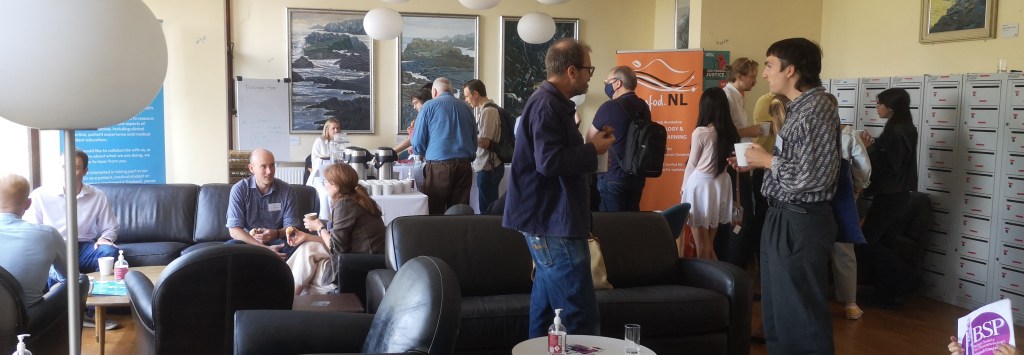
The Senior Common Room at Exeter Queens Building where the hanfod.NL banner had its 2nd outing

Congratulations to the teams (BSP & Exeter) on a brilliant event! It was a great privilege and pleasure to attend in-person after sampling online in 2020. I was a bit embarrassed to be thanked for chairing the methods session yesterday, when the hosts were all over it. I merely did a bit of sentence strangling, to allow a couple more questioners their say. Even that was made far easier by Zoe Waters who anchored the session.

Exeter Quay

I went to Exeter with few expectations but a fair bit of dread, and kept reminding myself of why I was going: literally fly the flag for hanfod.NL But fainter hopes were more than realised. It was so helpful to be exposed to a range of current scholars deploying a wide breadth of phenomenological ideas in a variety of ways. There were certainly opportunities to break the brain on thoroughgoing philosophy but also a range of ‘engaged’ papers. Even the read-out and zoom-streamed philosophy papers were more accessible at a conference. In her NLC2020 keynote, Prof Lesley Gourlay (sadly not at BSPAC2022 – one day Lesley 😉 raised the eventedness of lectures as special, and, if we aim for everything to be recorded, because we can, we risk consigning the arguably richer embodied congeniality of events to channel conducive, generative scholarly activity. At Cardiff’s graduation events, I missed the ceremonial announcement that we were ‘having a congregation’. When we concur to devote time and space of our short lives in these ways, it matters and the in-between chatter matters. In one conversation we reflected on how the pressure to raise production values messes with the messiness of exploring ideas, plainly admitting we do not have all the answers cuts against demands to be slick.

Exeter Cathedral in the sun, community café in shade

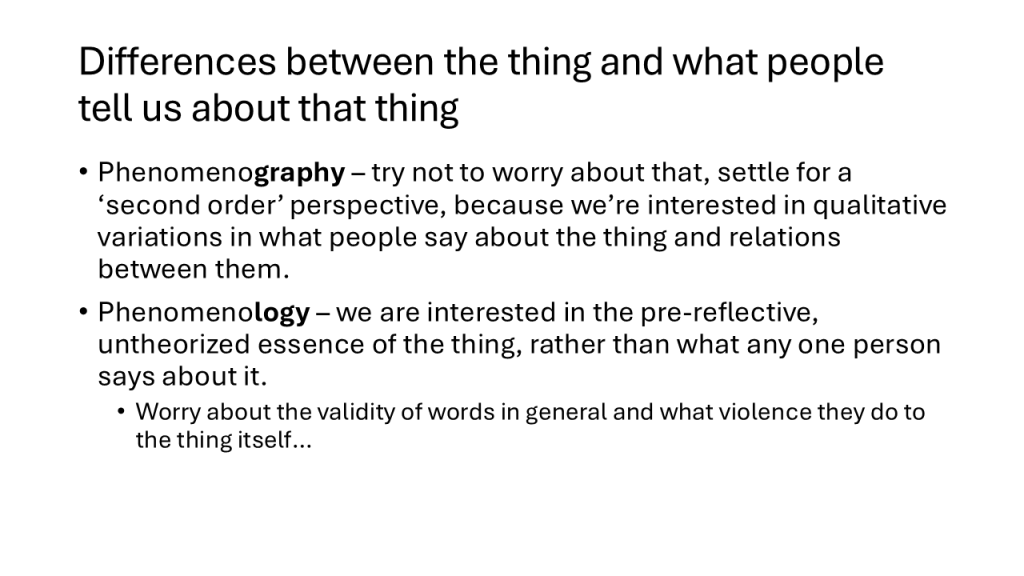
I don’t claim much depth to my phenomenology yet I was able to keep pace with many of the papers. Without mentioning names, someone in the methods session criticised the inherent reductivism in published frameworks that aim to help novice phenomenologists. Of course, such frameworks can be helpful, and this is especially the case where a ‘loose coupling’ leaves the researcher with guiding stars, rather than a prescriptive routine that squeezes out opportunities for developing reflexivity. Students can be in too much of a rush and instrumentalise the method instead of understanding it and their place in it. Phenomenology is beyond understanding for the best of us anyway… And yet, Max van Manen’s phenomenology of practice, not mentioned this week, does, for me, hit a sweet spot of impelling one to push for deeper grounding into the heart of phenomenology while laying out the parts in sufficient detail to avoid getting completely lost. Max was busy on a new edition of his 2014 book, so we were thrilled that his son, Michael van Manen, who did get a mention this week, agreed to present for us on the 14th (see previous blog post). I was not there to present a paper, at least I was able to encourage a few scholars even newer to phenomenology than I am: I was able to point to the place of oft dreaded canonical writers, drawing from Max van Manen’s framing them as ‘insight cultivators’. It’s not how much you cover, but how inspiring a sentence can be for analysis. With that in mind, I’ve set off on a 2-page per day odyssey with Merleau-Ponty’s Phenomenology of Perception. I’ve always believed in the importance of reading beyond oneself but MP seems harder than Gadamer! I will find my feet again in the Preface, which is more than enough to stretch the mind.

Statue of Floella Benjamin, famed Chancellor (not least for hugging graduating students rather than doffing or handshaking!

Back to the conference, another draw for me, and hanfod.NL interests, was that Dr Lucy Osler was presenting. One of her aims was to seek another way out of the dichotomy between technological optimism/pessimism and online/in-person sociality. A brilliant talk, there were clear links with the recent symposium papers and great potential for cultivation of insight!

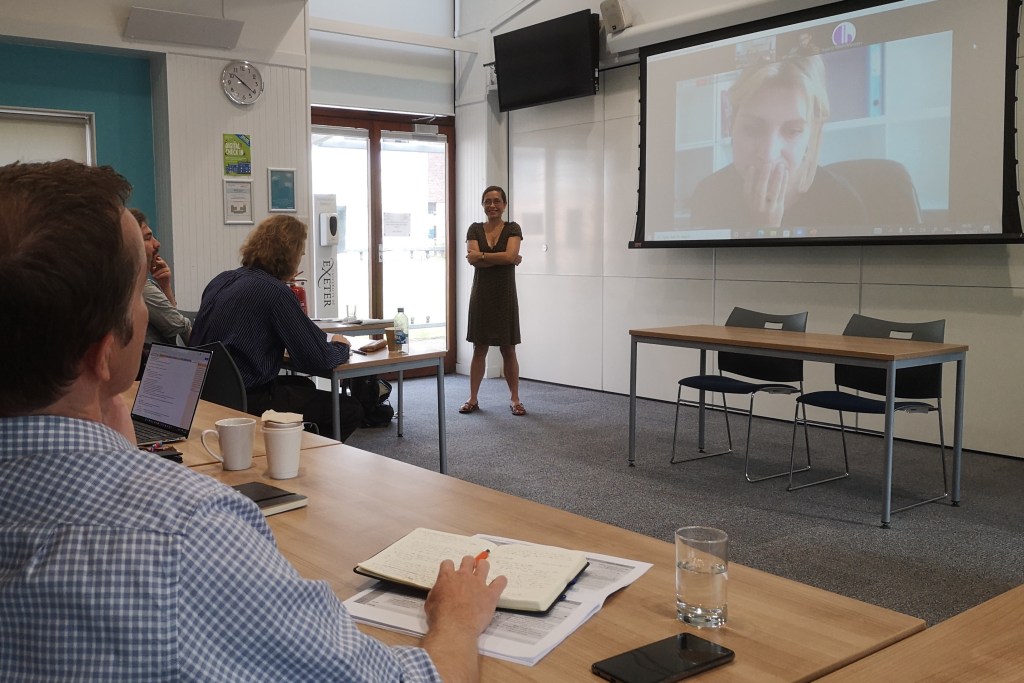
Lucy Osler beaming in from Copenhagen on the first day of her lectureship at Cardiff! Just outside is the well greased elbow of Matt Barnard, indefatigable in his support of the event – big thanks to him!