Excitement is brewing at hanfod.NL for a dynamic May!

Kicking Off with a Phenomenology Workshop in Cardiff
hanfod.NL is buzzing with excitement as we gear up for an exhilarating May, starting with our fully booked special event at our Cardiff University location. On the 10th of May, we’re delighted to host Professor Cathy Adams, our esteemed Phenomenologist in Residence, for a half-day workshop on Phenomenology of Practice. This event promises to be an insightful gathering, welcoming scores of participants eager to delve into the depths of phenomenological research.

Crossing Over to Malta for NLC24
Our journey continues as we cross the sea to the sunny shores of Malta for the Networked Learning Conference 2024 (NLC24), 15-17 May. We’re so eager to dive into the conference’s rich themes, including digital futures, environmental sustainability, the transformative impact of AI and emerging technologies, and the vital need for ethical innovation education, as well as pick up on our phenomenological notes. This year’s event is set to challenge our current understandings and inspire new perspectives in the realms of networked learning and digital integration.

Distinguished Keynote Speakers at NLC24
Known for her critical and ethnographic approaches, Professor Felicitas Macgilchrist will explore the cultural politics of educational technology, with a focus on critical, ethnographic, and speculative approaches to the educational landscape, Professor Alexiei Dingli of the University of Malta will address the profound impacts of artificial intelligence in educational settings, and Dr. Jen Ross, co-director of the Centre for Research in Digital Education at the University of Edinburgh, will share insights into the future of digital education.

Interactive Roundtable Discussion
Our own Nina, Cathy, Mike, and I are thrilled to be running an interactive roundtable that introduces our forthcoming ‘Phenomenology in Action for Researching Networked Learning Experiences’ edited collection, an addition to the Springer Book Series on Research in Networked Learning in 2024. We eagerly anticipate engaging with our esteemed discussants, meeting up with many of the book’s contributing authors, and furthering our phenomenological discussions.

A Week of Engaging Academic Exchange:
Throughout the week, the hanfod.NL team will be presenting our own papers. Yet this gathering is more than presentations and formal discussions; it’s a wonderful opportunity to connect, feed, and foster relationships while welcoming new voices into our lively community.

May we see you there and/or look forward to share!

Felicity and Mike

At last, we have a bank account!

Starting anything during the COVID lockdowns was going to be tricky but getting a bank account to manage the hnl21 event finances and such was humanly impossible. And it was not for want of trying. Several abortive trips around South Wales led to the unsatisfactory holding position of sharing one of our private accounts. Thankfully, we are all sorted now with an official ‘treasurer’s account’ with Lloyds so thanks to them for making the process relatively straightfoward, even if their error (about which they were profusely apologetic) led to a 2 month delay. In the scheme of things, that was not a big deal! We had used a gofundme page to take donations towards the hnl21 event but that’s shut due to inactivity. If you would like to send us money, please get in touch by email to info@hanfod.NL and we’ll share the relevant details.

We aim to provide full financial transparency to our ‘parent’ organisation, the Networked Learning Conference Consortium (NLCC) by providing a financial statement at our spring annual general meetings and our Chair, Nina, is also a core member of the business group of the NLCC.

Exploring networked learning and phenomenology

It was such a joy to meet up yesterday – with Dr Lucy Osler, Cardiff University philosophy and, in spite of many toils and trials, Dr Felicity Healey-Benson, in triumph following recent viva success!! Warmest congratulations to Felicity!!

Lucy joined Cardiff last summer from completing a post doc at the Center for Subjectivity Research at the University of Copenhagen, run by Dan Zahavi, attached to a project run by Thomas Szanto. We are thrilled that Lucy has agreed to provide an opening chapter for our collaboration, ‘Phenomenological Perspectives on Networked Learning’. Lucy aims to explain what philosophical phenomenology offers the field of networked learning and, since NL is a new field for her, we spent some time discussing its definition and distinctives. I am thrilled that Lucy is keen to help. Phenomenology has been a contested space, and many point to it as key to their research. There are all shades of claims made to verify a project’s phenomenological credentials, with anything from a brief mention of Husserl, to more elaborate frameworks. With our book, we aim to portray some of this diversity, disavowing sectarianism, but Lucy’s chapter should set us out with a voice from the same philosophical river of which Heidegger spoke.

I was happy to lend Lucy my copy of Chris Jones’ (2015) book and observed that many scholars coming afresh to NL struggle with the term, and even feel the need to seriously challenge it. I find it helpful to refer to Peter Goodyear’s blog post where he explains that, originally, networked learning was not ‘our’ choice, but that of a UK funding body:

In the circumstances – late 1990s, UK Higher Education – it was quite likely that Jisc would fund proposals that focussed only on individual use of online learning materials (given the interest in personalised learning and more efficient “delivery” of education). We were keen to create other opportunities: a more ambitious conception of what was possible and worthwhile. We weren’t introducing the term “Networked Learning” – we were expanding what it meant and beginning to shift the core of its meaning.

See  https://petergoodyear.net/2020/09/30/convivial-technologies-and-networked-learning/

Thus, arguably more central to whatever else we mean by networked learning these days is the keenly felt need to contend for education along ‘critical and emancipatory’ lines. Although the newer NL definition takes a post-digital approach by presuming ICT, rather than explicitly mentioning it, I tend to agree with Chris Jones who still (see NLEC et al. 2021) holds out for the importance of explicitly circumscribing the definition with information technology because otherwise NL is in danger of becoming a ‘theory of everything’, and, quite possibly, nothing of very much analytical purchase, or saying much more than good old humanism… which was how it felt at the SHRE ‘relational pedagogies’ book launch on Tuesday, surely ‘connections’ that NL scholars have been ‘promoting’ for decades. Yet we all need to keep an eye on Hannah Sfard’s wisdom,  ‘On Two Metaphors for Learning and the Dangers of Choosing Just One.’

Jones, C.R. 2015. Networked learning : an educational paradigm for the age of digital networks. London: Springer.

Networked Learning Editorial Collective (NLEC) et al. 2021. Networked Learning in 2021: A Community Definition. Postdigital Science and Education 3(2), pp. 326–369. doi: 10.1007/s42438-021-00222-y.

Osler, L. 2021. Taking empathy online. Inquiry , pp. 1–28. doi: 10.1080/0020174X.2021.1899045.

Osler, L. and Zahavi, D. 2022. Sociality and Embodiment: Online Communication During and After Covid-19. Foundations of Science . Available at: https://doi.org/10.1007/s10699-022-09861-1 [Accessed: 3 October 2022].

Sfard, A. (1998). On Two Metaphors for Learning and the Dangers of Choosing Just One. Educational Researcher, 27(2), 4. https://doi.org/10.2307/1176193

NLC2022 ‘Found Chord’ symposium papers link

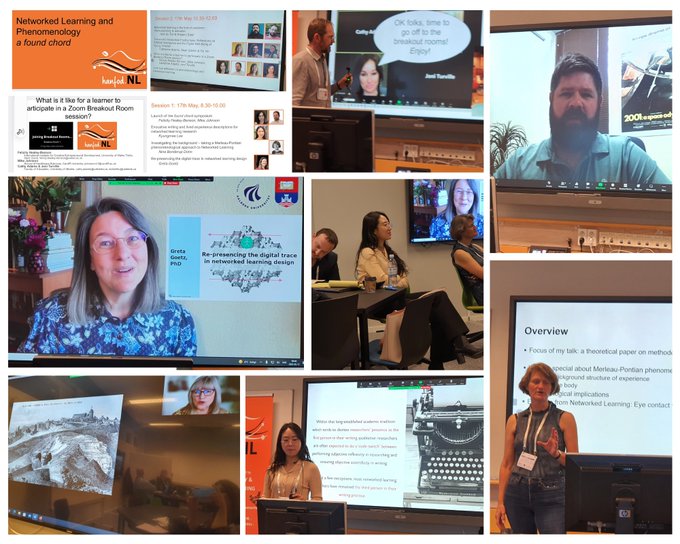
I remember well enjoying the 2020 conference from Cardiff and have fond memories of really important happenings, including hanfod.NL that arose from it. However, to be back in-person at Sundsvall was profoundly wonderful. I have some photos on flickr and Felicity composed brilliant montages, one of which is featured here but see the others and her brief write-up on her EmergentThinkers blog.

We are incredibly grateful to our fabulous partners especially because our combined work strengthened the conference and lay down a marker for phenomenology at it.

Montage from our ‘Found Chord’ symposium at NLC2022 (cc FH-B)

The papers have been made available on the conference website – this link to it might work for a while [I’ve also added the Zoom Breakout Room paper to my Cardiff Uni profile]. One of our next plans is to take the papers and create an edited collection with them. However, there may be room for a couple more contributions. If you have a good suggestion about that, please get in touch (via the contact form or email if you wish).

Introducing daisychain recordings with our first, by Greta

Daisy image CC by Kelbv on Flickr
A single daisy for our first recording in the daisy chain series – image CC Kelbv

To herald the Networked Learning Conference in May, we aim to release short audio reflections, linking with our symposium, and possibly each other’s recordings. Practically, we have in mind those who are curious about exploring networked learning and phenomenology, with the hope of inspiring more people to join in. However, part of the reason is that we just can’t keep quiet for long! – it must be admitted that there is an element of self-indulgent enthusiasm behind this mini-project 🌞

We love metaphors: daisy-chains are delicate, free, and carry a universal, humble beauty. They are often made in a shared between-time, and bestowed as a happy love gift in-person. We hope for you it is the thought that counts. When, as in the COVID-19 pandemic, mitsein (being-with, after Heidegger) may be in short supply, it behoves us, as we can, to humanise interactions and mitigate alienation. We hope hearing our voices will help you to connect more richly with us and the ideas we present. The voice alone is not video, but, as McLuhanesque hot media, may be all the more intriguing for that.

We are beyond delighted that Dr Greta Goetz, University of Belgrade, agreed to start us off. As one might expect, given her 2021 PDSE article, the recording is a singular work of scholarship in its own right, weaving many redolent ideas from her deep engagement with phenomenology. Mike (2008, p330) has styled information technology as ‘a chain of weak links’, which is also a feature of daisy chains, so we invite you to take advantage of the recording while it, the transcript and references, are still available. Honouring Greta’s authorship, the 11 minute recording is to be found on Greta’s site using this link.

References

Goetz, G. (2021). The Odyssey of Pedagogies of Technoscientific Literacies. Postdigital Science and Education, 3(2), 520–545. https://doi.org/10.1007/s42438-020-00188-3

Johnson, M. R. (2008). Investigating & encouraging student nurses’ ICT engagement. In T. T. Kidd & I. Chen (Eds.), Social Information Technology: Connecting Society and Cultural Issues (pp. 313–335). Information Science Reference.

McLuhan, M. (2001). Understanding media: The extensions of man. Routledge.

Planning for the symposium in NLC2022

We feel like our 10/11 June workshop was so long ago…. although it is a happy memory. Another small example of overcoming in the face of the pandemic… However, if you had a summer like us, writing was not easy to fit in. A busy life can really desiccate attempts to enter into a phenomenological attitude…

We hope you have managed to relax a little over the ‘holiday’ period – you may be still trying to do so.  However, we can’t rest on our laurels for long – we have started to properly look forward to next year’s in-person conference – a very exciting and hopeful prospect, given global events.

If you have time, take a look at this site which takes an informal look at the host city: http://www.sundsvalltown.se/ Mike really tried to find a land route to Kolding in 2020, and is wondering whether not flying is going to be a realistic option this time without having to immitate Phileas Fogg!

Nacksta Sankt Olof, Sundsvall, by Hans Lindqvist, CC BY-SA 4.0 https://creativecommons.org/licenses/by-sa/4.0, via Wikimedia Commons

One of hanfod.NL’s aims is to organise a phenomenology and networked learning symposium – the deadline for symposium proposals and full papers is the same –  October 8th. We need a clear idea about the viability of a symposium well in advance and so we’re inviting you to join us. Please email info@hanfod.nl with your abstract by 2nd September in order for us to meet online for feedback and review on the 3rd at 2pm (GMT) – you are welcome to join us. We will email the zoom link you if you send us your abstract.  

We look forward to hearing from you (soon 🙂

Great day! #hNL21 is full!

Looking at it pre-event, we can say that the hanfod.NL initiative has been a success, even though there are many alluring aims still in view, as Nina shared the other day. But today we celebrate a new challenge – being on the brink of oversubscribed for hNL21! The event is a workshop and this means we have to limit numbers to assure quality and feasibility of good facilitation.

Participants’ interests are wonderfully diverse. Some are new to phenomenology, others have taken the course with Cathy in Alberta. Some are young postgrads, others are academics of many years’ good standing. Some can trace a direct link with networked learning research, others are coming more for the methodology refresh with far flung research questions – this can only increase the chances of expanding everyone’s horizons!

A number of participants have so encouraged us with words expressing their delight at finding us, perhaps because they have felt isolated. Mutual encouragement is a big reason of we are here! Someone was moved enough to become our first GoFundMe donor (apart from Felicity and myself!)!

AND our dear friend Stig (University profile page) has provided us with a superb example of ‘insight cultivation’ in a VLOG that touches on Hd’s concept of ‘dwelling’ with reference to networked learning. This is exclusively available to event registrants. The VLOG is entitled, ‘Heidegger, Illich and networks: A short tale of how deictic discourse turned up on my social media.’ You can find out more through Stig’s new book, Philosophers of Technology.

Stig Børsen Hansen. Associate Professor, University of Southern Denmark

Sadly, we are unable to accept further registrations. We had considered over-offering or operating a waiting list but neither of these appeal at our scale. Nevertheless, our mission is ongoing and if you are interested in collaborating with us at the conference (where we hope to run a symposium and a workshop) and beyond, please do get in touch.

Titles and posts

Chair Change

hanfod.NL was generously supported by our Chair, Morten Kure Kattenhøj, as we came into being last year. Sadly for us all, he had to step back due to a departmental reorganisation. We want to thank Morten for his vital initial support in the early days, including in the run-up to the last conference.

We are delighted to announce his successor: Professor Nina Bonderup-Dohn. With Nina as Chair, hanfod.NL has a vital umbilical connection with the Networked Learning Conference Consortium. Nina has already gifted her wealth of advice but the day-to-day running of hanfod.NL is still being handled by Mike and Felicity.

hanfod.NL Ffenomenolegydd Preswyl’ – Phenomenologist in Residence

Along with appointing a new Chair, we acknowledge the contribution of Professor Cathy Adams. It’s thus both fitting and exciting that Cathy has agreed to take up the position of ‘hanfod.NL Ffenomenolegydd Preswyl*’- Phenomenologist in Residence’, a nominal post for two years initially. This is probably the first-ever time that this phrase has been coined. We recognise the remarkable contribution that Cathy has made to the field, and to hanfod.NL in particular. When we started hanfod.NL we could not have imagined that someone as prominent and prestigious as Cathy would give so generously and patiently of her time to run several many hours-long meetings with us, helping us develop our phenomenological practice. We thank Cathy for her work, support and openness to work with scholars of different hues.


*Ffenomenolegydd Preswyl – for our non-Welsh speakers

/fɛnɒmɛnoˈlɛgɨð ˈprɛswɪl/ (IPA version – international phonetic alphabet)

fen-om-en-ol-egi-the prez-wil (COG version – common or garden – note that the underlines indicate an emphasis on the penultimate syllable and that the ‘the’ is trying to get you to pronounce the Welsh letter ‘dd’, so, a bit like ‘th’ as in ‘the’ (i.e. try saying ‘them’ without the ’em’).