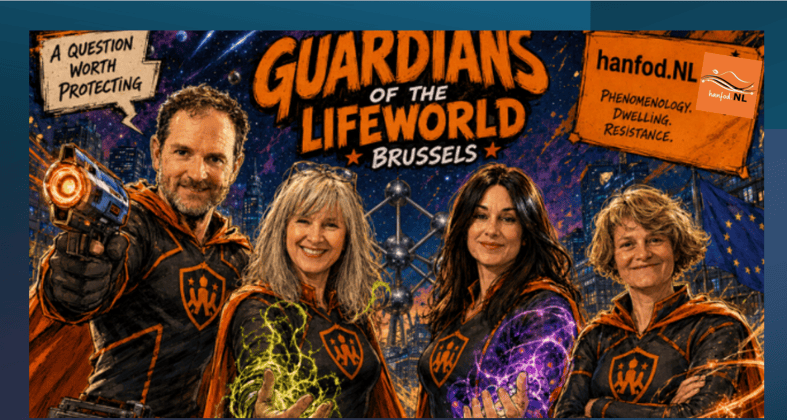
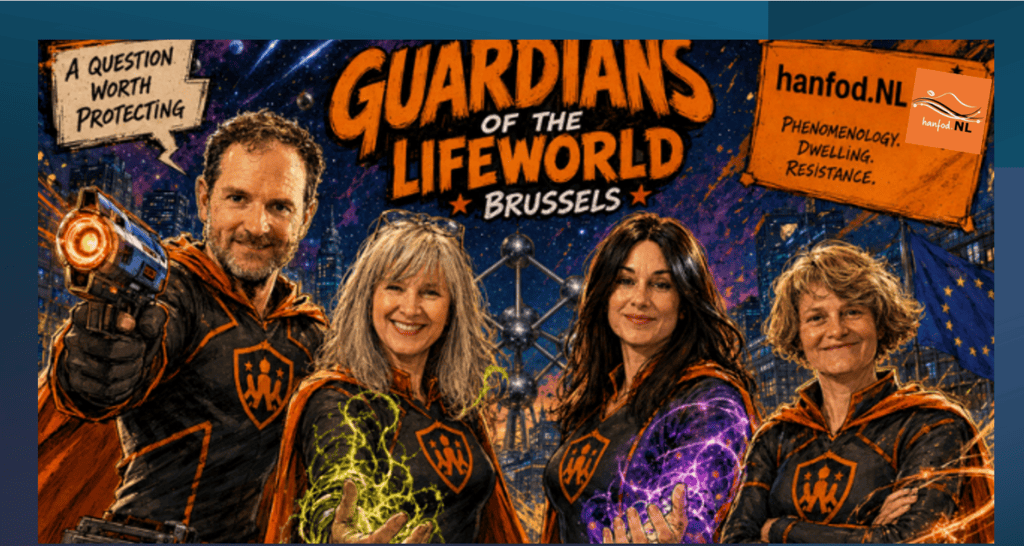
There is a tradition now at hanfod.NL of bringing phenomenology to the Networked Learning Conference with a little orange accompaniment. It began with our hNL21 node event in 2021, followed by orange beanies and badges at NLC Sundsvall in 2022, where we celebrated our double symposium and the collaborators who helped make it possible. In Malta in 2024, orange socks marked the pre-launch of our Springer edited collection Phenomenology in Action for Researching Networked Learning, with Professors Cathy Adams and Nina Bonderup Dohn joining Mike and me as the hanfod.NL four. For NLC Brussels 2026, we decided metaphorical orange superpants were called for. If you are going to suggest that phenomenology might help guard the conditions of human thinking in an age of technological acceleration, you might as well dress for the occasion.
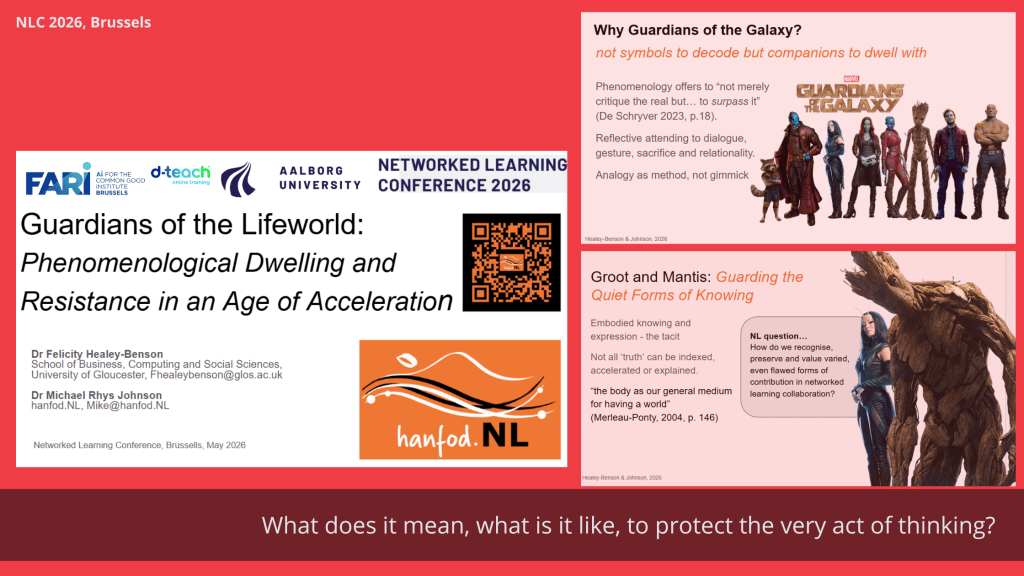
At the Fifteenth International Conference on Networked Learning in Brussels/Ixelles, our paper, Guardians of the Lifeworld: Phenomenological Dwelling and Resistance in an Age of Acceleration, brought the latest strand of hanfod.NL thinking into the NLC conversation. The work grew from our Springer edited collection, from a generative conversation with Cathy and Nina during a hanfod.NL meeting in March 2025, and from a question that neither of us could quite shake: in an era where large language models accelerate, automate and optimise, what does it mean to protect the very act of human thinking? Not thinking simply as information processing or efficient output, but thinking as a mode of dwelling.
We found some unlikely companions in the Guardians of the Galaxy. Rather than treating them as characters to decode, we dwelt with them phenomenologically. Star-Lord, Gamora, Rocket, Nebula, Groot, Mantis and Drax offered different ways into questions of memory, ethical orientation, intervention, healing and relational forms of knowing that resist easy capture. Through them, we explored what we called humanity sidelined: fragments of post-digital scholarly practice where technological intervention can get in the way of humans humanly benefiting from their own scholarly activity. Our concern is not simply technological error or hallucination. It is what might happen when uncertainty is resolved before it has been inhabited, when the difficult encounter with research material is shortened or bypassed, or when the messy grappling through which understanding develops is replaced by something already fluent, ordered and finished.
One of the striking reflections emerging from Brussels was that phenomenology seemed to be triggering something. People appeared drawn towards it while sometimes struggling to articulate quite why. That space between recognising something and not yet possessing the language for it is territory phenomenology knows rather well. Our Guardians offer no simple solution to technological acceleration, nor were they intended to. They offer persistence, responsiveness and an invitation to remain with what resists capture.
The Brussels conference was not, however, the end of this particular inquiry. We are delighted that Guardians of the Lifeworld has since been selected as one of 15 NLC2026 conference papers invited for development into a chapter for the forthcoming edited Networked Learning volume, currently working under the title Care, brokering and learning in technology-entangled times. The opportunity allows us not simply to reproduce the conference paper, but to develop the thinking further. Some of that development was already beginning in the conversations generated at NLC2026: dwelling more deeply with the Guardians, exploring what collective guardianship might mean, and addressing questions raised around metaphorical analysis.
So, the work is in progress, which seems rather fitting. For hanfod.NL, phenomenology has never been something finished that we simply apply. It asks us to stay with what is unfolding, disturb what has become taken for granted, and sometimes find language for something we sensed before we could articulate it. The conference paper is published, now the chapter is becoming.
Felicity
 hanfod.NL