Book review in PDSE

We are thrilled to thank Maria (University of Malta profile) for the recently published review of our book in Post-Digital Science and Education. Since it began in 2019, this journal has served so well as a locus for networked learning outputs, with many, especially critical, shared values. Many NL scholars appear in the first issue, likely due to Petar’s successful hosting of the 2018 conference in Zagreb. I recall Chris Jones telling me that some of the original NL conference team had considered but rejected the idea of starting another journal for NL outputs, favouring JCAL instead, as perhaps indicated by that journal hosting a special issue in 2008.

As Maria notes, her review started life in a round table event at the Malta NL conference earlier this year. Inspired by Nina, we invited four discussants to spend ten minutes each to share their reflections on the book. It was a wonderful time, superbly captured by Felicity’s blog post. Knowing how difficult that it can be to finish collaborative writing projects, the promise made in May, to bring the round table’s essence into print seemed unlikely to bear fruit. But I should have more faith in our wonderful friends. Thank you Maria!

Maarten, Thomas and Maria, closing the conference.
Fabulous Maria, closing the 2024 Networked Learning Conference (Maarten and Thomas suitably stunned)

Phenomenology Café (pilot) in-person 12th July 15.30 Roath Park Lake Café

Arising from our workshop in May, I was delighted to meet Dr Ruan Jones (academia.edu profile, linkedin profile), fairly recently moved to Cardiff Metropolitan University (Cardiff Met) from Leeds Becket. Car trouble frustrated Ruan’s attendance at the workshop, so I was keen to make up for that. Ruan was doubly keen to meet, given his doctorate and because he’d run phenomenology workshops for years at Leeds Becket. 

To cut to the chase, we’re hoping to meet monthly and invite you to join us at the Terra Nova café (googlemaps link) for a Phenomenology Café (pilot) in-person 12th July 15.30 Roath Park Lake Café. If you want to know when we plan to meet next, please email info@hanfod.nl

Scott Memorial in Roath Park

Excitement is brewing at hanfod.NL for a dynamic May!

Kicking Off with a Phenomenology Workshop in Cardiff
hanfod.NL is buzzing with excitement as we gear up for an exhilarating May, starting with our fully booked special event at our Cardiff University location. On the 10th of May, we’re delighted to host Professor Cathy Adams, our esteemed Phenomenologist in Residence, for a half-day workshop on Phenomenology of Practice. This event promises to be an insightful gathering, welcoming scores of participants eager to delve into the depths of phenomenological research.

Crossing Over to Malta for NLC24
Our journey continues as we cross the sea to the sunny shores of Malta for the Networked Learning Conference 2024 (NLC24), 15-17 May. We’re so eager to dive into the conference’s rich themes, including digital futures, environmental sustainability, the transformative impact of AI and emerging technologies, and the vital need for ethical innovation education, as well as pick up on our phenomenological notes. This year’s event is set to challenge our current understandings and inspire new perspectives in the realms of networked learning and digital integration.

Distinguished Keynote Speakers at NLC24
Known for her critical and ethnographic approaches, Professor Felicitas Macgilchrist will explore the cultural politics of educational technology, with a focus on critical, ethnographic, and speculative approaches to the educational landscape, Professor Alexiei Dingli of the University of Malta will address the profound impacts of artificial intelligence in educational settings, and Dr. Jen Ross, co-director of the Centre for Research in Digital Education at the University of Edinburgh, will share insights into the future of digital education.

Interactive Roundtable Discussion
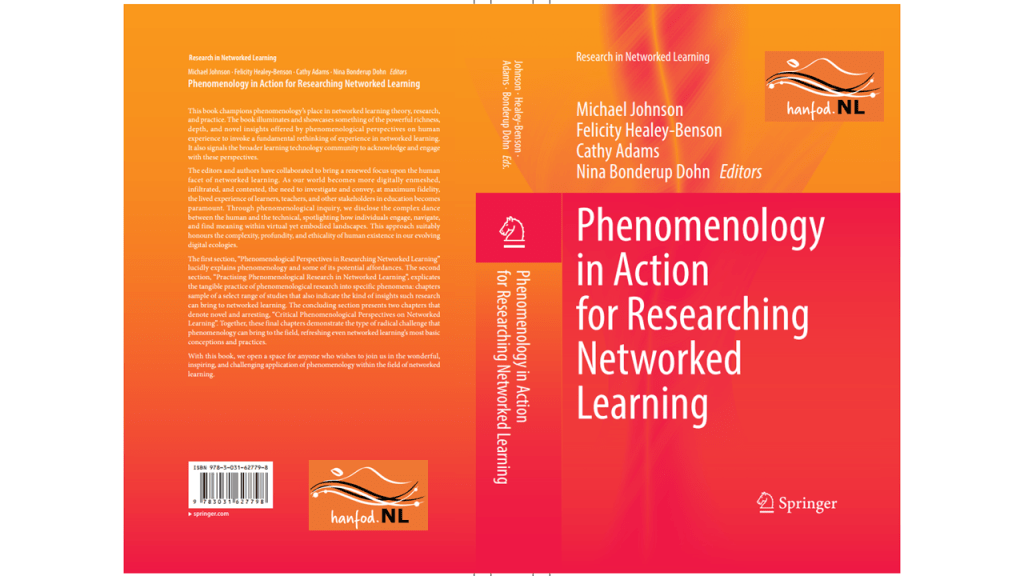
Our own Nina, Cathy, Mike, and I are thrilled to be running an interactive roundtable that introduces our forthcoming ‘Phenomenology in Action for Researching Networked Learning Experiences’ edited collection, an addition to the Springer Book Series on Research in Networked Learning in 2024. We eagerly anticipate engaging with our esteemed discussants, meeting up with many of the book’s contributing authors, and furthering our phenomenological discussions.

A Week of Engaging Academic Exchange:
Throughout the week, the hanfod.NL team will be presenting our own papers. Yet this gathering is more than presentations and formal discussions; it’s a wonderful opportunity to connect, feed, and foster relationships while welcoming new voices into our lively community.

May we see you there and/or look forward to share!

Felicity and Mike

UPDATED: FULL! Cathy Adams’ workshop 10th May 2024 in Cardiff

We seem to have attracted some attention for the workshop! The form below is now operating as a waiting list. Apologies if you miss out 🙏 The event is fully subscribed and we have more than enough on a waiting list (we’ll be informing these good people at the end of the month) so the sign-up form is now closed to new responses. We hope to run more events/workshops in future so please subscribe to the blog for updates or get in touch using the contact page. For more information on the approach Cathy is leading on, see:

  • Adams, C., & van Manen, M. A. 2017. Teaching Phenomenological Research and Writing. Qualitative Health Research, 27(6), 780–791. https://doi.org/10.1177/1049732317698960
  • Errasti-Ibarrondo, B., Jordán, J.A., Díez-Del-Corral, M.P. and Arantzamendi, M. 2018. Conducting phenomenological research: Rationalizing the methods and rigour of the phenomenology of practice. Journal of Advanced Nursing 74(7), pp. 1723–1734. doi: 10.1111/jan.13569

We have been seeing this coming for a while and so are suitably delighted to announce an in-person phenomenology workshop led by our Ffenomenolegydd Preswyl (Phenomenologist in Residence) Professor Cathy Adams! Cathy has a sabbatical which will take in many stops on this side of the Atlantic, including at the Networked Learning Conference in Malta. 

Please do share widely and book your place through this form which has all the details: https://forms.office.com/e/4EwpLP1H23

Scholarship, and wonder

With an eye to Gadamer’s elaboration of Bildung (in Truth and Method), I wrote the following response to a call for members of my immediate academic community to define scholarship. Many have already made excellent points about pedagogic research, etc., through a collaborative padlet. For example, citing the work of Minocha and Collins (2023), Impact of Scholarship of Teaching and Learning: A guide for educators. The Open University, Milton Keynes, UK. DOI: https://doi.org/10.21954/ou.ro.000155c1

I felt something was missing:

One of the problems with HE is the sense that time and effort must be maximally instrumentalised, ‘for profit’, ‘to increase productivity/effectiveness’, and pedagogic research may be a case in point… But scholarship has an element of obliging one-self in self-cultivating, keeping oneself open to what is ‘other’, towards an ideal that owns ‘no goals outside itself’; it is no mere means to an end. This implies a strong place for theory, and especially that which is discomforting, even alienating, beyond the immediate and familiar. 
For this, the scholar must enjoy a state of unhurried psychological safety. Until the university patently prizes its scholars’ time, for too many this will remain an irritating pipe-dream glanced at from the treadmill. 

I felt there is a resemblance here to the phenomenological reduction which requires an opening of the self to wonder, as when confronted with the majesty of creation (pic from a recent trip to Cadair Idris). Without this move, can we escape the circular self.

Double sunset over Barmouth from Cadair Idris, by Mike

Exploring networked learning and phenomenology

It was such a joy to meet up yesterday – with Dr Lucy Osler, Cardiff University philosophy and, in spite of many toils and trials, Dr Felicity Healey-Benson, in triumph following recent viva success!! Warmest congratulations to Felicity!!

Lucy joined Cardiff last summer from completing a post doc at the Center for Subjectivity Research at the University of Copenhagen, run by Dan Zahavi, attached to a project run by Thomas Szanto. We are thrilled that Lucy has agreed to provide an opening chapter for our collaboration, ‘Phenomenological Perspectives on Networked Learning’. Lucy aims to explain what philosophical phenomenology offers the field of networked learning and, since NL is a new field for her, we spent some time discussing its definition and distinctives. I am thrilled that Lucy is keen to help. Phenomenology has been a contested space, and many point to it as key to their research. There are all shades of claims made to verify a project’s phenomenological credentials, with anything from a brief mention of Husserl, to more elaborate frameworks. With our book, we aim to portray some of this diversity, disavowing sectarianism, but Lucy’s chapter should set us out with a voice from the same philosophical river of which Heidegger spoke.

I was happy to lend Lucy my copy of Chris Jones’ (2015) book and observed that many scholars coming afresh to NL struggle with the term, and even feel the need to seriously challenge it. I find it helpful to refer to Peter Goodyear’s blog post where he explains that, originally, networked learning was not ‘our’ choice, but that of a UK funding body:

In the circumstances – late 1990s, UK Higher Education – it was quite likely that Jisc would fund proposals that focussed only on individual use of online learning materials (given the interest in personalised learning and more efficient “delivery” of education). We were keen to create other opportunities: a more ambitious conception of what was possible and worthwhile. We weren’t introducing the term “Networked Learning” – we were expanding what it meant and beginning to shift the core of its meaning.

See  https://petergoodyear.net/2020/09/30/convivial-technologies-and-networked-learning/

Thus, arguably more central to whatever else we mean by networked learning these days is the keenly felt need to contend for education along ‘critical and emancipatory’ lines. Although the newer NL definition takes a post-digital approach by presuming ICT, rather than explicitly mentioning it, I tend to agree with Chris Jones who still (see NLEC et al. 2021) holds out for the importance of explicitly circumscribing the definition with information technology because otherwise NL is in danger of becoming a ‘theory of everything’, and, quite possibly, nothing of very much analytical purchase, or saying much more than good old humanism… which was how it felt at the SHRE ‘relational pedagogies’ book launch on Tuesday, surely ‘connections’ that NL scholars have been ‘promoting’ for decades. Yet we all need to keep an eye on Hannah Sfard’s wisdom,  ‘On Two Metaphors for Learning and the Dangers of Choosing Just One.’

Jones, C.R. 2015. Networked learning : an educational paradigm for the age of digital networks. London: Springer.

Networked Learning Editorial Collective (NLEC) et al. 2021. Networked Learning in 2021: A Community Definition. Postdigital Science and Education 3(2), pp. 326–369. doi: 10.1007/s42438-021-00222-y.

Osler, L. 2021. Taking empathy online. Inquiry , pp. 1–28. doi: 10.1080/0020174X.2021.1899045.

Osler, L. and Zahavi, D. 2022. Sociality and Embodiment: Online Communication During and After Covid-19. Foundations of Science . Available at: https://doi.org/10.1007/s10699-022-09861-1 [Accessed: 3 October 2022].

Sfard, A. (1998). On Two Metaphors for Learning and the Dangers of Choosing Just One. Educational Researcher, 27(2), 4. https://doi.org/10.2307/1176193

Phenomenology of Practice in full colour

Felicity and I are deeply grateful for Professor Michael van Manen’s seminar yesterday. Prior organisation was a little stilted by email, and the announcement somewhat belated. Nevertheless, we were encouraged by the turnout, a respectful group of almost 50 tuned in. Michael gracefully took us through an illustrated tour of phenomenology of practice, with reference to the ‘Classic Writings’ book and his own research related to his work as a neonatologist.

Professor van Manen presenting

Michael kindly allowed us to record the presentation although his use of many evocative images makes it impossible to share very widely. If you would like to view, please get in touch with us using the info@hanfod.NL email address.

Here are references shared in the seminar:

Networked Learning Editorial Collective (NLEC) et al. 2021. Networked Learning in 2021: A Community Definition. Postdigital Science and Education 3(2), pp. 326–369. doi: 10.1007/s42438-021-00222-y.

van Manen, Max 2016. Researching lived experience: human science for an action sensitive pedagogy. Second Edition. London New York: Routledge, Taylor & Francis Group.

van Manen, Michael 2012. Carrying: Parental Experience of the Hospital Transfer of Their Baby. Qualitative Health Research 22(2), pp. 199–211. doi: 10.1177/1049732311420447.

van Manen, Michael 2018. Phenomenology of the Newborn: Life from Womb to World. 1st edition. New York: Routledge.

van Manen, Michael and van Manen, Max 2021. Classic writings for a phenomenology of practice. New York: Routledge. Available at: https://public.ebookcentral.proquest.com/choice/publicfullrecord.aspx?p=6280232 [link to CU Library record]

I stopped recording at the start of the question/discussion part to help everyone feel less inhibited. I have anonymised and reproduced the four questions and answers here though:

Continue reading “Phenomenology of Practice in full colour”

hanfod.NL on the road – BSP in Exeter!

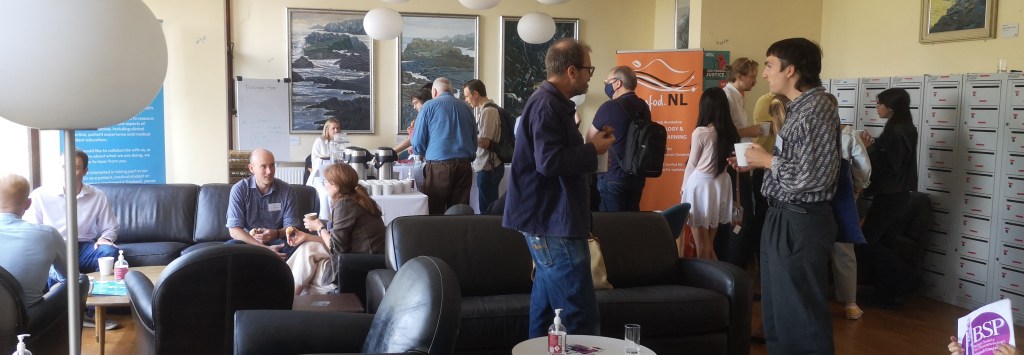
The Senior Common Room at Exeter Queens Building where the hanfod.NL banner had its 2nd outing

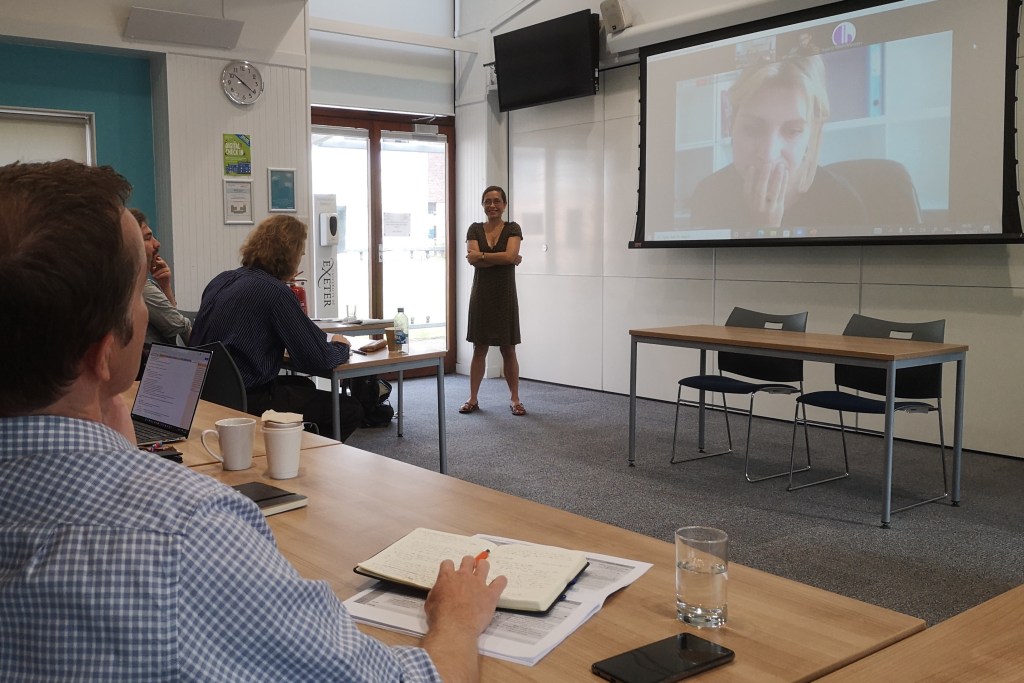
Congratulations to the teams (BSP & Exeter) on a brilliant event! It was a great privilege and pleasure to attend in-person after sampling online in 2020. I was a bit embarrassed to be thanked for chairing the methods session yesterday, when the hosts were all over it. I merely did a bit of sentence strangling, to allow a couple more questioners their say. Even that was made far easier by Zoe Waters who anchored the session.

Exeter Quay

I went to Exeter with few expectations but a fair bit of dread, and kept reminding myself of why I was going: literally fly the flag for hanfod.NL But fainter hopes were more than realised. It was so helpful to be exposed to a range of current scholars deploying a wide breadth of phenomenological ideas in a variety of ways. There were certainly opportunities to break the brain on thoroughgoing philosophy but also a range of ‘engaged’ papers. Even the read-out and zoom-streamed philosophy papers were more accessible at a conference. In her NLC2020 keynote, Prof Lesley Gourlay (sadly not at BSPAC2022 – one day Lesley 😉 raised the eventedness of lectures as special, and, if we aim for everything to be recorded, because we can, we risk consigning the arguably richer embodied congeniality of events to channel conducive, generative scholarly activity. At Cardiff’s graduation events, I missed the ceremonial announcement that we were ‘having a congregation’. When we concur to devote time and space of our short lives in these ways, it matters and the in-between chatter matters. In one conversation we reflected on how the pressure to raise production values messes with the messiness of exploring ideas, plainly admitting we do not have all the answers cuts against demands to be slick.

Exeter Cathedral in the sun, community café in shade

I don’t claim much depth to my phenomenology yet I was able to keep pace with many of the papers. Without mentioning names, someone in the methods session criticised the inherent reductivism in published frameworks that aim to help novice phenomenologists. Of course, such frameworks can be helpful, and this is especially the case where a ‘loose coupling’ leaves the researcher with guiding stars, rather than a prescriptive routine that squeezes out opportunities for developing reflexivity. Students can be in too much of a rush and instrumentalise the method instead of understanding it and their place in it. Phenomenology is beyond understanding for the best of us anyway… And yet, Max van Manen’s phenomenology of practice, not mentioned this week, does, for me, hit a sweet spot of impelling one to push for deeper grounding into the heart of phenomenology while laying out the parts in sufficient detail to avoid getting completely lost. Max was busy on a new edition of his 2014 book, so we were thrilled that his son, Michael van Manen, who did get a mention this week, agreed to present for us on the 14th (see previous blog post). I was not there to present a paper, at least I was able to encourage a few scholars even newer to phenomenology than I am: I was able to point to the place of oft dreaded canonical writers, drawing from Max van Manen’s framing them as ‘insight cultivators’. It’s not how much you cover, but how inspiring a sentence can be for analysis. With that in mind, I’ve set off on a 2-page per day odyssey with Merleau-Ponty’s Phenomenology of Perception. I’ve always believed in the importance of reading beyond oneself but MP seems harder than Gadamer! I will find my feet again in the Preface, which is more than enough to stretch the mind.

Statue of Floella Benjamin, famed Chancellor (not least for hugging graduating students rather than doffing or handshaking!

Back to the conference, another draw for me, and hanfod.NL interests, was that Dr Lucy Osler was presenting. One of her aims was to seek another way out of the dichotomy between technological optimism/pessimism and online/in-person sociality. A brilliant talk, there were clear links with the recent symposium papers and great potential for cultivation of insight!

Lucy Osler beaming in from Copenhagen on the first day of her lectureship at Cardiff! Just outside is the well greased elbow of Matt Barnard, indefatigable in his support of the event – big thanks to him!

Webinar 14 Sept 22, 2pm (UK): Michael van Manen

We are thrilled to announce a webinar featuring Michael van Manen (University of Alberta profile page). Endowed Chair in Health Ethics, Michael is the Director of the John Dossetor Health Ethics Centre, and an Associate Professor in the Department of Paediatrics.

Michael van Manen

In just over three weeks time, on 14th September, Michael has very kindly agreed to rise early to help us understand phenomenology of practice from his perspective as a neonatologist (see webinar abstract below). We have scheduled 60 minutes for the presentation, leaving 30 more for questions and discussion.

Image: DrParthShah, CC BY-SA 4.0 https://creativecommons.org/licenses/by-sa/4.0, via Wikimedia Commons

Among other notable contributions, Michael recently collaborated with his father, Max, to publish Classic Writings for a Phenomenology of Practice. This is an important work to support and demonstrate the heritage of the Phenomenology of Practice approach, also documented in the 2021 paper Doing Phenomenological Research and Writing.

A link to Michael’s recent discussion of Medical Ethics is offered below.

Webinar Abstract: Phenomenology of Practice: Ethics, Phenomenology, Value
What does it mean to do phenomenology directly on the phenomena that we live?

What distinguishes phenomenology as a method compared to other human science traditions?

How may phenomenology offer relevance and value to professional practitioners such as teachers, nurses, doctors, social workers, or other caring professions?

Phenomenology does not have to be an impenetrable philosophy but instead may be realized as a method to sensitively explore and explicate everyday human experiences.

Such understandings offer insights into the everyday ethics implicit in the practices of practitioners.

In this talk, I will discuss the tradition of phenomenology of practice, and the intersections of ethics, phenomenology, value, and technology at the hand of several health research projects. I hope to show the value of phenomenology for practice and also the value of practice for phenomenology.

We do hope you will join us on the day. Please email info@hanfod.nl for the Zoom joining link or download this ics calendar file. We hope to record the session so you can catch up if you are unable to attend online.

Introducing daisychain recordings with our first, by Greta

Daisy image CC by Kelbv on Flickr
A single daisy for our first recording in the daisy chain series – image CC Kelbv

To herald the Networked Learning Conference in May, we aim to release short audio reflections, linking with our symposium, and possibly each other’s recordings. Practically, we have in mind those who are curious about exploring networked learning and phenomenology, with the hope of inspiring more people to join in. However, part of the reason is that we just can’t keep quiet for long! – it must be admitted that there is an element of self-indulgent enthusiasm behind this mini-project 🌞

We love metaphors: daisy-chains are delicate, free, and carry a universal, humble beauty. They are often made in a shared between-time, and bestowed as a happy love gift in-person. We hope for you it is the thought that counts. When, as in the COVID-19 pandemic, mitsein (being-with, after Heidegger) may be in short supply, it behoves us, as we can, to humanise interactions and mitigate alienation. We hope hearing our voices will help you to connect more richly with us and the ideas we present. The voice alone is not video, but, as McLuhanesque hot media, may be all the more intriguing for that.

We are beyond delighted that Dr Greta Goetz, University of Belgrade, agreed to start us off. As one might expect, given her 2021 PDSE article, the recording is a singular work of scholarship in its own right, weaving many redolent ideas from her deep engagement with phenomenology. Mike (2008, p330) has styled information technology as ‘a chain of weak links’, which is also a feature of daisy chains, so we invite you to take advantage of the recording while it, the transcript and references, are still available. Honouring Greta’s authorship, the 11 minute recording is to be found on Greta’s site using this link.

References

Goetz, G. (2021). The Odyssey of Pedagogies of Technoscientific Literacies. Postdigital Science and Education, 3(2), 520–545. https://doi.org/10.1007/s42438-020-00188-3

Johnson, M. R. (2008). Investigating & encouraging student nurses’ ICT engagement. In T. T. Kidd & I. Chen (Eds.), Social Information Technology: Connecting Society and Cultural Issues (pp. 313–335). Information Science Reference.

McLuhan, M. (2001). Understanding media: The extensions of man. Routledge.