How does your research methodology impact methods?
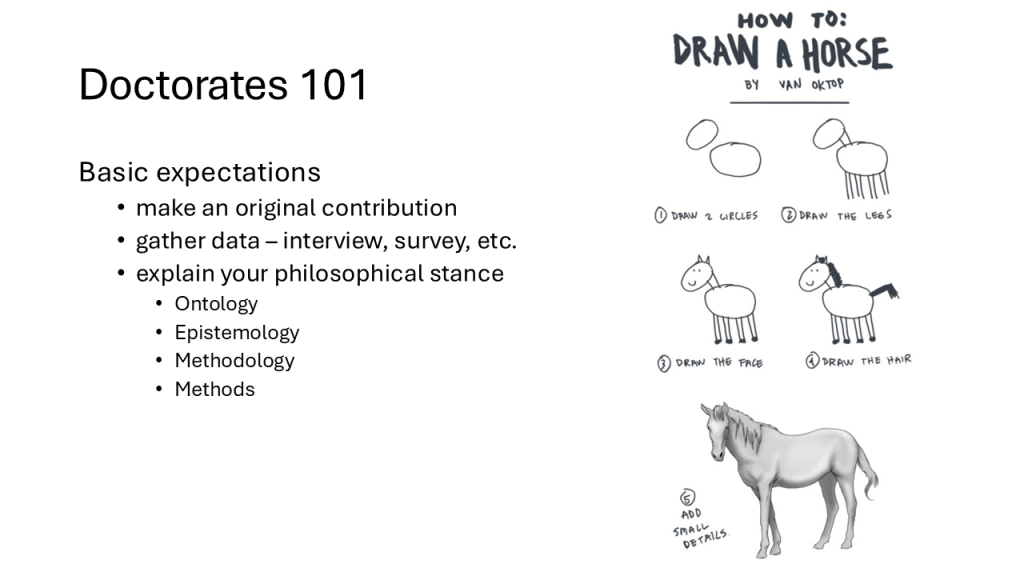
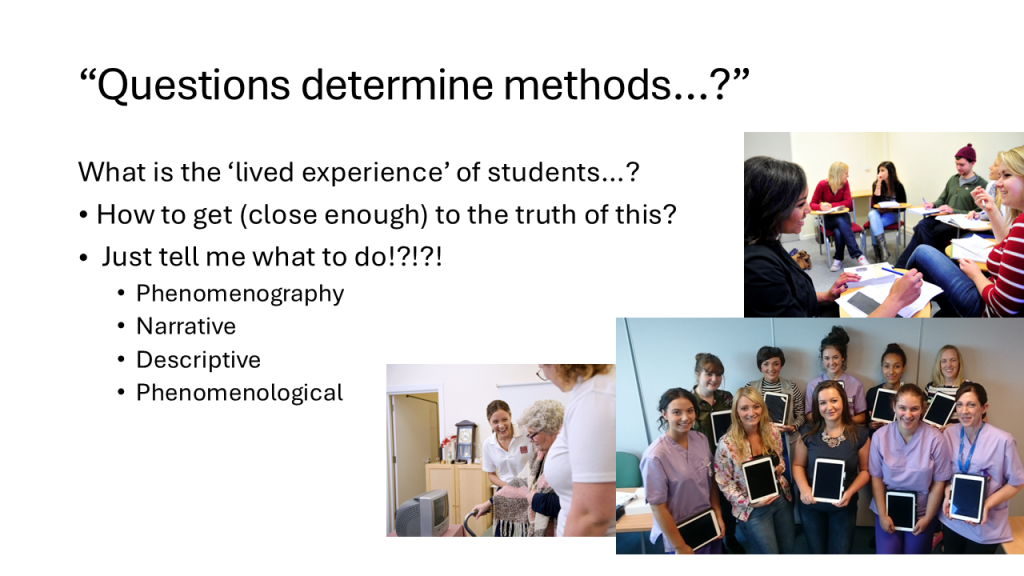
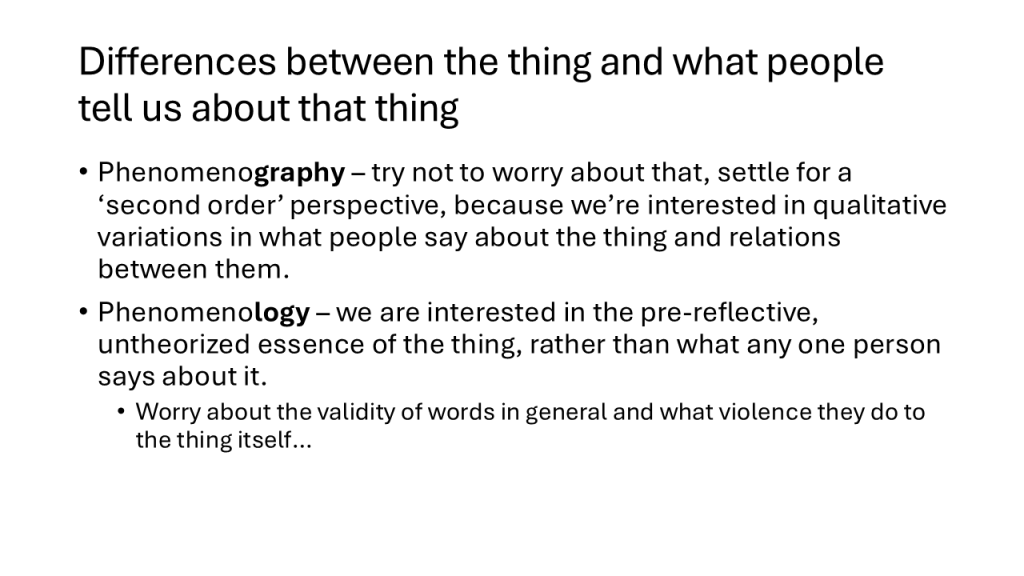
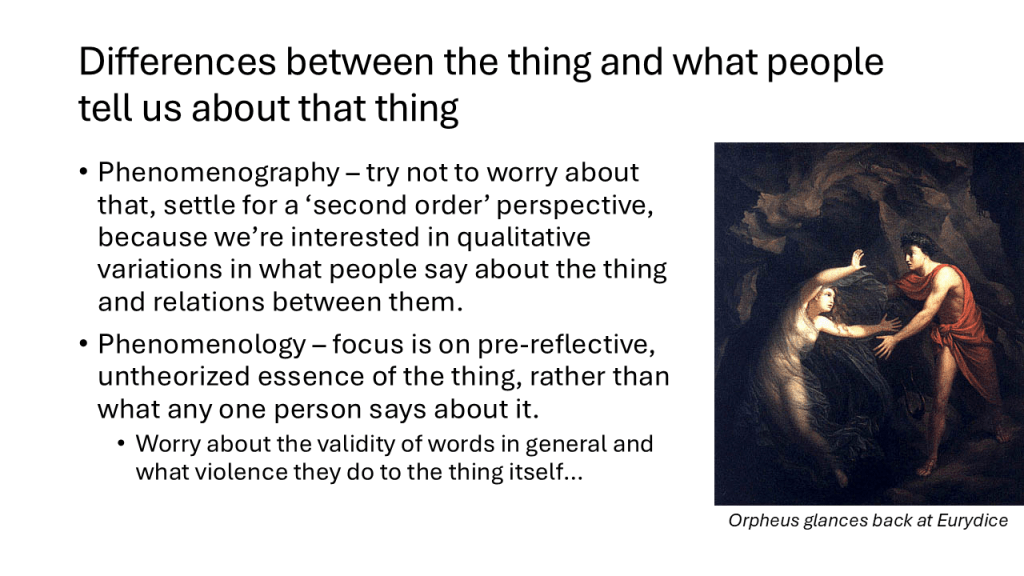
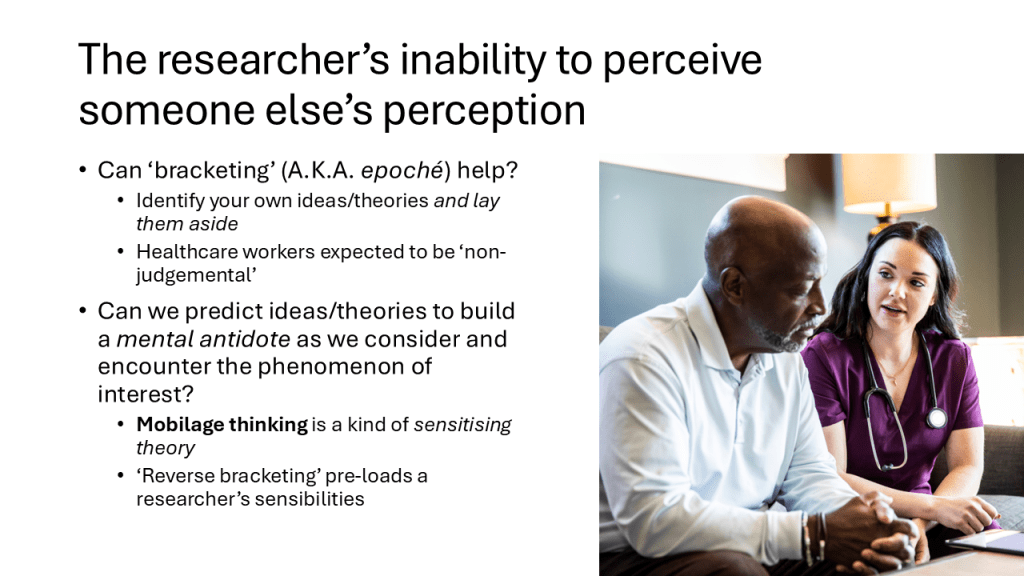
This blog has been rather quiet for various reasons but, as we are cruising towards the next Networked Learning Conference (NLC), the time is ripe (if not very overdue) to share some media, including the video (poor sound though sorry), from my ‘short paper’ presentation in Malta 2024, slides as images below. I’ve hosted the video on archive.org because there are less concerns about big tech profiteering over there, however this also may mean the video does not play, or not play smoothly for you. There’s a link to the submitted paper below.
We at hanfod.NL have some exciting plans for the coming conference and I’ll share more in another post.
The paper highlights one of the key methodological insights from my doctoral thesis and recent book chapter. At the conference, in short form, the paper was a provocation, as much as anything, trying to encourage researchers to reflect on what exactly they think they have when they gather data. In many areas of research it is presumed that data will be collected, analysed, and presented. However, there are so many assumptions made all along that method. One thing that phenomenology teaches us is that there is a gap between some thing and what we notice about it, and probably even more drift between the thing and what other people tell us about it. Phenomenologists try to account for this gap by focusing on the phenomena, rather than the person’s individual experience of that phenomena (which should ring alarm bells for readers who want phenomenology to be ‘ideographic’, focusing on an individual’s experience). This is why we have ‘bracketing’: we may wish to try and exclude some thoughts as polluting my conscious distilling of the essence of a phenomenon. To whatever extent this may be possible, my paper suggests that we may also wish to actively pre-load our thinking as we approach data gathering. If human science values the human researcher as the premiere research instrument, more attention could be given to the researcher’s frame of mind in those epic moments when phenomena are encountered.
Johnson, M. R. (2024). Mobilage thinking and empirical encounters: Data gathering and analysis of networked learning experiences. Proceedings of the International Conference on Networked Learning , 14(1). https://doi.org/10.54337/nlc.v14i1.8087
With higher education’s funding in a mess, Felicity and I continue giving ‘side of the desk’ attention to hanfod.NL (i.e., for free) but now without the supporting infrastructure of an academic post. Nevertheless, we’re still committed to the field, and the ground we broke up for ourselves:
We’ve got a couple of papers in for next May’s NLC, both quite novel, and fun even! I heard a rumor that at least one new phenomenological voice could be joining us in Belgium… 🤫
Arising from our workshop in May, I was delighted to meet Dr Ruan Jones (academia.edu profile, linkedin profile), fairly recently moved to Cardiff Metropolitan University (Cardiff Met) from Leeds Becket. Car trouble frustrated Ruan’s attendance at the workshop, so I was keen to make up for that. Ruan was doubly keen to meet, given his doctorate and because he’d run phenomenology workshops for years at Leeds Becket.
To cut to the chase, we’re hoping to meet monthly and invite you to join us at the Terra Nova café (googlemaps link) for a Phenomenology Café (pilot) in-person 12th July 15.30 Roath Park Lake Café. If you want to know when we plan to meet next, please email info@hanfod.nl
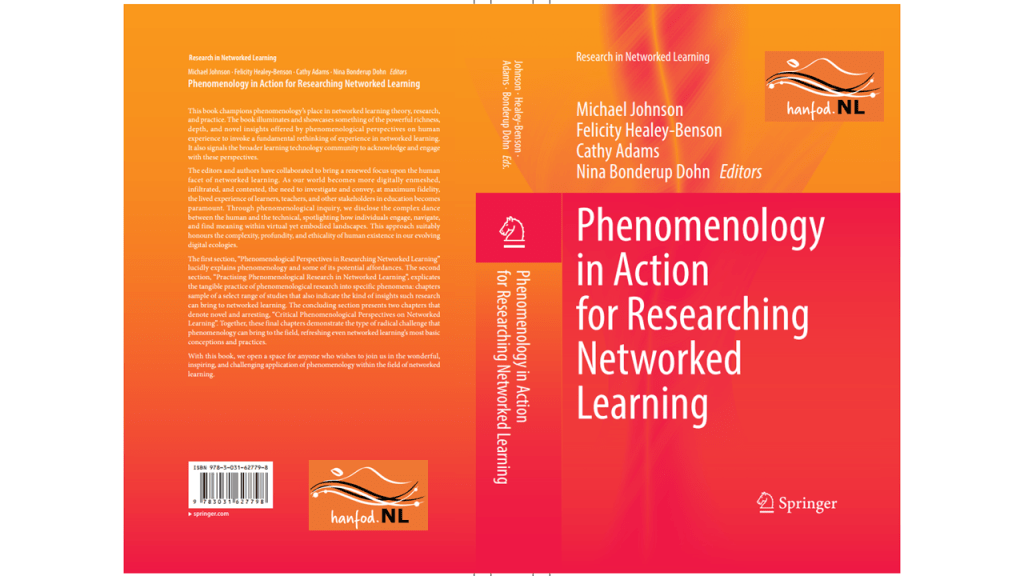
The recent roundtable discussion on our forthcoming Springer book Phenomenology in Action for Researching Networked Learning at the 14th International Networked Learning Conference hosted by the University of Malta was an enriching experience. As editors and authors, Mike, Cathy, Nina, and I were humbled by the thoughtful perspectives and valuable insights shared by our esteemed roundtable discussants.
Dr Maria Cutajar of the University of Malta began with comments that underscored the depth and rigour demanded by phenomenological inquiry, while also acknowledging its transformative potential. She emphasised the book’s invitation to think more deeply about our experiences as humans in an increasingly digital world.
Professor Mark Vagle, dialling in from Minnesota, appreciated the book’s nuanced engagement with different phenomenological approaches, highlighting its recognition of phenomenology as plural. He commended the framing questions that guided each section, drawing attention to the emphasis on what phenomenological investigations can reveal and how phenomenology can challenge networked learning.
Professor Lesley Gourlay’s reflections resonated deeply. She spoke about the importance of slowness, stillness, and attending to the ineffable aspects of experience – qualities that phenomenology can help surface. Lesley highlighted the book’s potential to push back against the transhumanist ethos and open up new ways of understanding lived experiences in educational contexts.
Professor Emeritus Vivien Hodgson, a pioneering figure in networked learning, raised thought-provoking questions about the relationship between phenomenology and autoethnography, and the possibilities of integrating creative non-fiction writing techniques. Her insights shed light on how phenomenological approaches could enable richer, more empathetic understandings of lived experiences.
The discussants’ reflections reinforced our belief in the value of phenomenological perspectives for researching networked learning. Their insights have further inspired us to continue exploring the roles, possibilities, and challenges of using phenomenology to understand the complexities of human experiences in digital learning environments.
We are grateful for the engaging discussion and the opportunity to share our work with the networked learning community in Malta. We were also very excited to have some of our contributing authors join us in person – Associate Professor Kyungmee Lee, Seoul National University and Professor Greta Goetz, Belgrade University.
As we move forward, we hope this book will serve as a catalyst for more phenomenological inquiries, deepening our understanding of the lived experiences that shape and are shaped by networked learning practices. We now look forward to the official publication month this year, and to communicate our online event to celebrate with you and our full complement of book contributors. We hope also to share with the Postdigital Science and Education Journal, facilitated by Professor Petar Jandric, Zagreb University.
Felicity, on behalf of Dr Mike Johnson, Professor Cathy Adams, & Professor Nina Bonderup Dohn.
Maria Cutajar PhD is a Senior Lecturer in Arts, Open Communities and Adult Education at the University of Malta.
Mark D. Vagle PhD is a Professor at the University of Minnesota, USA. He has written extensively on phenomenological research in journals such as Qualitative Inquiry
Lesley Gourlay PhD is a Professor of Education, University College London.
Vivien Hodgson PhD is an Emeritus Professor of Networked Management Learning at Lancaster University Management School.
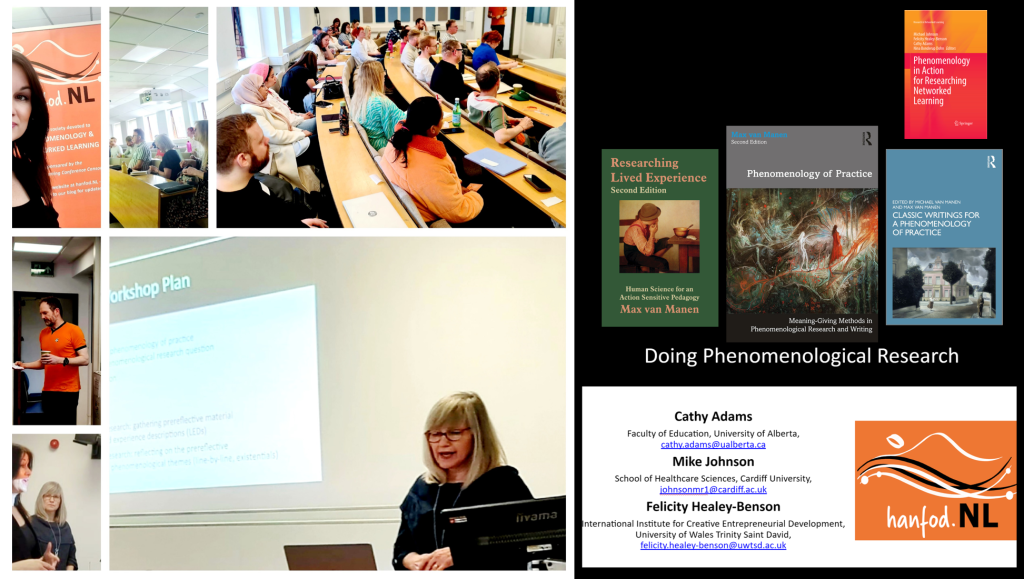
We are delighted to report on Friday’s much-anticipated #hNL24 Phenomenology of Practice workshop in Cardiff with Professor Cathy Adams. It was an enriching and thought-provoking experience for the wide range of participants from various backgrounds and stages of scholarship and professional practice. Enthusiastically sharing her extensive expertise and passion for phenomenological inquiry, Cathy guided the group through the philosophical underpinnings of van Manen’s Phenomenology of Practice, drawing from the works of influential thinkers like Merleau-Ponty, Sartre, and Heidegger. Her nuanced explanations elucidated core phenomenological concepts such as the phenomenological attitude, the phenomenological reduction, and a wondering attentiveness to lived experience.
With clarity and wisdom, Cathy demonstrated phenomenological research techniques like developing phenomenological research questions, gathering rich lived experience descriptions through interviewing, and reflecting on the data to uncover experiential meanings and structures. The interactive activities allowed participants to practice these methods hands-on.
The diverse perspectives and experiences represented by attendees from fields like health sciences, education, philosophy, and more enabled engaging discussions. The day was awash with open exchange and an atmosphere of curiosity and respect for the complexities of human experiences.
Overall, this workshop provided participants with philosophical depth and practical phenomenological methodologies to pursue insightful qualitative inquiries into the meanings of lived experiences across disciplines. Mike and I are so very grateful for the support of the Network Learning Consortium, and for the ongoing contribution of Cathy, hanfod.NL’s Phenomenologist in Residence, who has invested so heartily of her time during her sabbatical period in the UK.
We look forward to continuing our journey together at NLC24 in Malta this week.
As the sun bathed Swansea Bay in a golden glow today, Mike and I had the pleasure of welcoming the distinguished Professor Cathy Adams to our coastline, setting the stage for tomorrow’s highly anticipated Phenomenology of Practice Workshop in Cardiff.
After months of meticulous planning across various time zones, the opportunity to finally gather in person was nothing short of a phenomenological event in itself. While virtual meetings, email exchanges, and collaborative documents served as our initial platforms, there was an undeniable magic in engaging in face-to-face dialogue in the here and now.
Today’s meeting proved to be immensely fruitful, setting the tone not only for tomorrow but also for the ongoing development of hanfod.NL. The day concluded on a high note with the exciting reveal of the proof of our forthcoming Phenomenology in Action for Researching Networked Learning book’s cover, co-edited with Professor Nina Bonderup Dohn.
We hope you have all had the chance to read our recent pre-workshop communications on email. We are looking forward to seeing you all in the morning!
Just a week away now until our highly anticipated phenomenology workshop with Professor Cathy Adams! The response has been absolutely overwhelming—we’re fully booked with a waiting list for entry. The enthusiasm surrounding this event is palpable. We couldn’t be more excited. Our event Padlet has been buzzing with activity, with attendees introducing themselves and sharing their backgrounds and interests. It’s adding another layer of anticipation as we countdown to our gathering.
Kicking Off with a Phenomenology Workshop in Cardiff hanfod.NL is buzzing with excitement as we gear up for an exhilarating May, starting with our fully booked special event at our Cardiff University location. On the 10th of May, we’re delighted to host Professor Cathy Adams, our esteemed Phenomenologist in Residence, for a half-day workshop on Phenomenology of Practice. This event promises to be an insightful gathering, welcoming scores of participants eager to delve into the depths of phenomenological research.
Crossing Over to Malta for NLC24 Our journey continues as we cross the sea to the sunny shores of Malta for the Networked Learning Conference 2024 (NLC24), 15-17 May. We’re so eager to dive into the conference’s rich themes, including digital futures, environmental sustainability, the transformative impact of AI and emerging technologies, and the vital need for ethical innovation education, as well as pick up on our phenomenological notes. This year’s event is set to challenge our current understandings and inspire new perspectives in the realms of networked learning and digital integration.
Distinguished Keynote Speakers at NLC24 Known for her critical and ethnographic approaches, Professor Felicitas Macgilchrist will explore the cultural politics of educational technology, with a focus on critical, ethnographic, and speculative approaches to the educational landscape, Professor Alexiei Dingli of the University of Malta will address the profound impacts of artificial intelligence in educational settings, and Dr. Jen Ross, co-director of the Centre for Research in Digital Education at the University of Edinburgh, will share insights into the future of digital education.
Interactive Roundtable Discussion Our own Nina, Cathy, Mike, and I are thrilled to be running an interactive roundtable that introduces our forthcoming ‘Phenomenology in Action for Researching Networked Learning Experiences’ edited collection, an addition to the Springer Book Series on Research in Networked Learning in 2024. We eagerly anticipate engaging with our esteemed discussants, meeting up with many of the book’s contributing authors, and furthering our phenomenological discussions.
A Week of Engaging Academic Exchange: Throughout the week, the hanfod.NL team will be presenting our own papers. Yet this gathering is more than presentations and formal discussions; it’s a wonderful opportunity to connect, feed, and foster relationships while welcoming new voices into our lively community.
May we see you there and/or look forward to share!
We seem to have attracted some attention for the workshop! The form below is now operating as a waiting list. Apologies if you miss out 🙏The event is fully subscribed and we have more than enough on a waiting list (we’ll be informing these good people at the end of the month) so the sign-up form is now closed to new responses. We hope to run more events/workshops in future so please subscribe to the blog for updates or get in touch using the contact page. For more information on the approach Cathy is leading on, see:
Adams, C., & van Manen, M. A. 2017. Teaching Phenomenological Research and Writing. Qualitative Health Research, 27(6), 780–791. https://doi.org/10.1177/1049732317698960
Errasti-Ibarrondo, B., Jordán, J.A., Díez-Del-Corral, M.P. and Arantzamendi, M. 2018. Conducting phenomenological research: Rationalizing the methods and rigour of the phenomenology of practice. Journal of Advanced Nursing 74(7), pp. 1723–1734. doi: 10.1111/jan.13569
We have been seeing this coming for a while and so are suitably delighted to announce an in-person phenomenology workshop led by our Ffenomenolegydd Preswyl (Phenomenologist in Residence) Professor Cathy Adams! Cathy has a sabbatical which will take in many stops on this side of the Atlantic, including at the Networked Learning Conference in Malta.
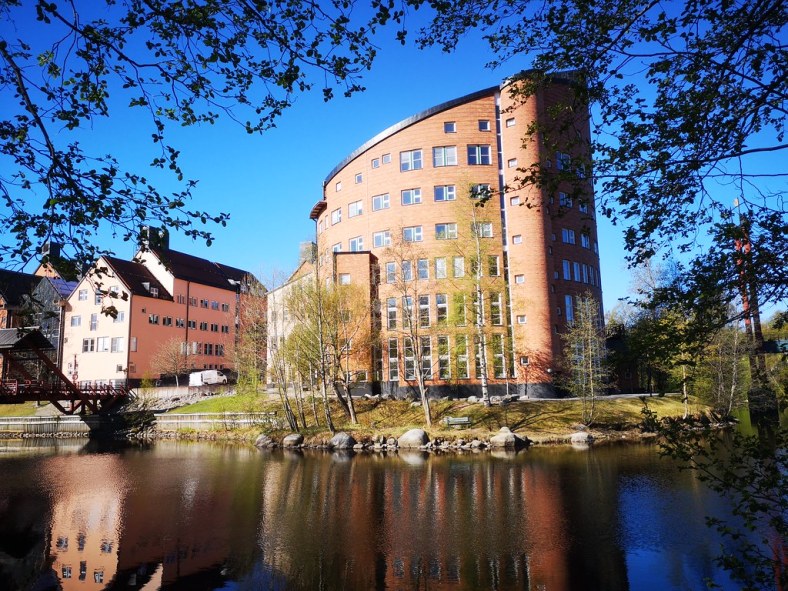
Mike and I are excited to announce that the hanfod.NL team will be participating in the 14th International Conference on Networked Learning (NLC2024), set to take place in Malta from 15-17 May 2024. This announcement comes with a blend of anticipation and pride, as we reflect on our productive engagement at NLC2022 in Sundsvall, Sweden, where our double symposium and phenomenology of practice workshop proposals were warmly received.
As we prepare for NLC2024, our excitement is twofold. Not only will phenomenology feature prominently among the conference themes, but we are also on the cusp of introducing the forthcoming Springer book, Phenomenology in Action for Researching Networked Learning. This work, which includes contributions and reflections from contributors to NLC2022, seeks to bridge the gap in networked learning research by focusing on phenomenological research methods, insights, and challenges.
The book is structured around critical inquiries into phenomenological research in networked learning, offering readers a comprehensive guide to conducting meaningful investigations within this domain. Through a collection of chapters, we explore the application of phenomenology to networked learning, revealing new dimensions of human experience and interaction facilitated by digital technologies.
Engage with Us at NLC2024
Join us in Malta for what promises to be an enriching experience. Our participation will include a Round Table designed to spotlight and deliberate on the upcoming new edition to the Springer Book Series on Research in Networked Learning. The session’s overarching goal, orchestrated by our book’s editorial team—Mike, Cathy, Nina, and myself, is to further delve into the integration of phenomenology within the domain of networked learning. We will commence with a concise introduction to the book, followed by insightful critiques and reflections from our four distinguished invited discussants. Their evaluations will set the stage for a broader conversation with attendees about the utility, opportunities, and hurdles associated with employing phenomenological approaches in the study of networked learning. In addition to the editorial team, numerous authors who contributed to the book will also be present, ready to engage in dialogue and provide their unique insights into the discussions. We eagerly encourage active participation from all conference attendees at the round table, aiming for a vibrant exchange of ideas and perspectives
As we continue our journey, we remain committed to advancing the field of networked learning through critical inquiry, collaborative exploration, and a shared sense of wonder in the face of the world’s educational challenges and opportunities.
We look forward to seeing you in Malta and to furthering our collective explorations into the rich terrain of networked learning and phenomenology.
We try and avoid hyperbole, but Dr Kyungmee’s next job seems really amazing. At the end of the month, she’s relocating from Lancaster’s CTEL, to join the Department of Education at Seoul National University, South Korea as Associate Professor in Qualitative Research Methodology. Her task: bring qualitative research to South Korea, where a very high proportion of research outputs are quantitative.
Kyungmee was keen to visit us in Wales for a number of reasons, apart from simply sharing the same time and space to discuss ideas in-person, which was a wonderful privilege. Kyungmee is contributing a chapter to our book, and I’ve known her since 2014 when I started the CTEL doctoral programme. Since then we’ve also popped up at the Networked Learning Conferences together, and hopefully we’ll meet again in Malta for NLC there next year. Hope you can join us!
Yesterday, for an hour in the Glamorgan Council Chamber, we piggy-backed onto Cardiff University School of Social Sciences’ education research seminar series for 2022-23, with a session exploring the claims/discourses around Artificial Intelligence with respect to qualitative research. Kyungmee noticed that AI does not ‘struggle’, indeed that is a selling point, where AI promises to alleviate struggle and help us achieve ‘better research findings’ in a ‘smarter’ way and outputs that we can have greater confidence in. This can be seen in marketing for recent AI enhancements to ATLAS.ti, a popular qualitative data analysis platform. But are AI shortcuts legitimate to authentically develop deep insights into human experiences, such as those featured in a recent ‘Autoethnography’ special issue of Studies in Technology Enhanced Learning, where authors are concerned with workplace bullying, discrimination, institutional racism…?? AI discourses play into dominant wider (meta-)discourses of an ‘economic-pragmatic nature, that demands fast, efficient, predictable and controllable productivity from the educational institutions.” (Hodgson et al. 2012, p300, drawing upon Levinson & Nielsen’s use of Dyson, 1999). This is at least a paradox when also considering educational trajectories that cherish students’ development towards autonomous and collaborative criticality and creativity. In our post-digital era, student and researcher already faced an existential threat from information over-production, a seemingly ever-growing barrier to enter and stay abreast of almost any field. AI solutions to the processes of literature reviewing seem benign, and even helpful. But the discourses around AI invite us to distrust humans: ‘Data has a better idea’. This runs counter to ground that qualitative researchers had presumed they occupied. As De Silva and El-Ayoubi (2023) indicate, all aspects of human science question ideation, method selection, data analysis, writing up and review, could be outsourced to software. Neoliberal higher education is sucking us dry with imperatives to do more with less: churn high-ranking impactful outputs under conditions of diminishing salaries, career uncertainty and over-work. We’re tired. Even while writing this, WordPress is suggesting that AI can make up for my humanity – how ironically demeaning.
Nevertheless, Kyungmee said, qualitative researchers contend that, “humans are political beings in unique historical contexts, with our own struggles, perspectives, experiences, and narratives that are subjective and partial.” We must continue to expose social inequalities, the lived experiences of struggle, power relationships/conflicts in people’s complex and nuanced ordinary everyday human life. In the face of Big Data and AI, autoethnography sails in the opposite direction. Indeed, the graft of writing is so bound up in autoethnography and phenomenology it is hard to see a place for AI, unless we meant Authentic Intelligence.
Dr Kyungmee Lee at the Glamorgan Building Council Chamber
Dyson, A. 1999. Inclusion and inclusions: theories and discourses in inclusive education. In: Daniels, H. and Garner, P. eds. World yearbook of education. 1999: Inclusive education. London: Kogan Page, pp. 36–53.
Hodgson, V., McConnell, D., & Dirckinck-Holmfeld, L. (2012). The Theory, Practice and Pedagogy of Networked Learning. In L. Dirckinck-Holmfeld, V. Hodgson, & D. McConnell (Eds.), Exploring the Theory, Pedagogy and Practice of Networked Learning (pp. 291–305). Springer New York.
Levinsen, K. T., & Nielsen, J. (2012). Innovating Design for Learning in the Networked Society. In L. Dirckinck-Holmfeld, V. Hodgson, & D. McConnell (Eds.), Exploring the Theory, Pedagogy and Practice of Networked Learning (pp. 237–256). Springer New York.
To our friends of hanfod.NL, following our exciting engagement at the 13th conference in Sweden in May 2022 we are thrilled to share the Call for Papers for the 14th International Conference on Networked Learning in Higher Education, Lifelong Learning and Professional Development.
The overarching theme of the conference is “Networked Learning as a pedagogy of hope” and some of the key themes are:
Digital futures and environmental renaissance
Artificial intelligence, learning analytics and emergent digital technologies
Ethical and responsible innovation and research
The conference is hosted by the University of Malta, at the Valletta Campus in Malta, on May 15-17, 2024.
Keynote Speakers:
Jen Ross – University of Edinburgh, Scotland
Alexei Dingli – University of Malta, Malta
Felicitas Macgilchrist – University of Goettingen, Germany
Key Dates:
Full/short papers or symposia proposals must be submitted by 6th October, 2023
Workshops/Round tables must be submitted by 17th November, 2023
Notification of acceptance by 15th December, 2023
All submissions are peer reviewed, and accepted submissions are published in the conference proceedings. Selected papers are invited for publication in an edited book as part of the Springer book series “Research in Networked Learning”.
We will be there and encourage you to join this vibrant community of scholars, educators, and innovators.
Mark your calendars for May 15-17, 2024 for this exciting event at the picturesque Valletta Campus. Don’t miss this opportunity to connect, learn, and inspire at a conference that embraces the pedagogy of hope.
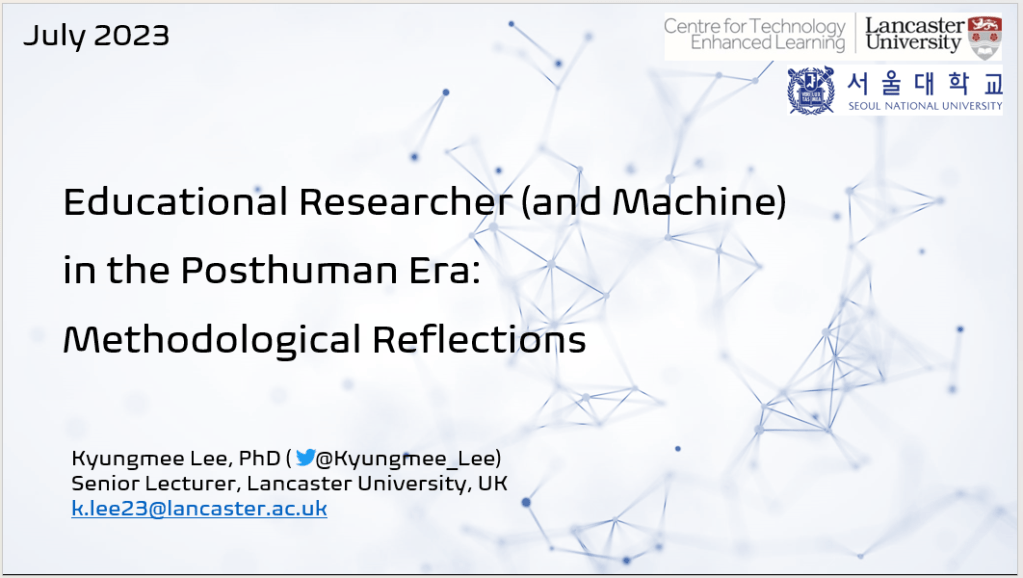
The title of her talk will be ‘Educational Researcher (and Machine) in the Posthuman Era: Methodological Reflections.‘
There has been increasing enthusiasm for and conversation on machine-assisted research innovation in the broad field of education and social sciences. This seminar will provide a brief overview of popular claims—both positive and negative—about fast-emerging posthuman conditions; and unpack some of the dominant discourses of innovative machine-assisted research approaches. The ‘back-to-person’ and ‘back-to-basic’ methodological approaches, exemplified by autoethnography and evocative academic writing, will be discussed as a critical alternative approach to rethinking machine-assisted research and researchers.
Who is Kyungmee??
Senior Lecturer in the Department of Educational Research at Lancaster University. Kyungmee is a co-editor of Studies in Technology Enhanced Learning. Her research targets the intersection of online education, adult education, and international education concerning issues of accessibility and inclusivity. Using a range of qualitative research methodologies and evocative academic writings, her current projects investigate the academic experiences of diverse non-traditional student groups in distance education settings. Kyungmee’s scholarship emphasises concepts of discourse, knowledge and power, understood through a broadly Foucauldian lens.
Felicity and I are deeply grateful for Professor Michael van Manen’s seminar yesterday. Prior organisation was a little stilted by email, and the announcement somewhat belated. Nevertheless, we were encouraged by the turnout, a respectful group of almost 50 tuned in. Michael gracefully took us through an illustrated tour of phenomenology of practice, with reference to the ‘Classic Writings’ book and his own research related to his work as a neonatologist.
Professor van Manen presenting
Michael kindly allowed us to record the presentation although his use of many evocative images makes it impossible to share very widely. If you would like to view, please get in touch with us using the info@hanfod.NL email address.
Here are references shared in the seminar:
Networked Learning Editorial Collective (NLEC) et al. 2021. Networked Learning in 2021: A Community Definition. Postdigital Science and Education 3(2), pp. 326–369. doi: 10.1007/s42438-021-00222-y.
van Manen, Max 2016. Researching lived experience: human science for an action sensitive pedagogy. Second Edition. London New York: Routledge, Taylor & Francis Group.
van Manen, Michael 2012. Carrying: Parental Experience of the Hospital Transfer of Their Baby. Qualitative Health Research 22(2), pp. 199–211. doi: 10.1177/1049732311420447.
van Manen, Michael 2018. Phenomenology of the Newborn: Life from Womb to World. 1st edition. New York: Routledge.
I stopped recording at the start of the question/discussion part to help everyone feel less inhibited. I have anonymised and reproduced the four questions and answers here though:
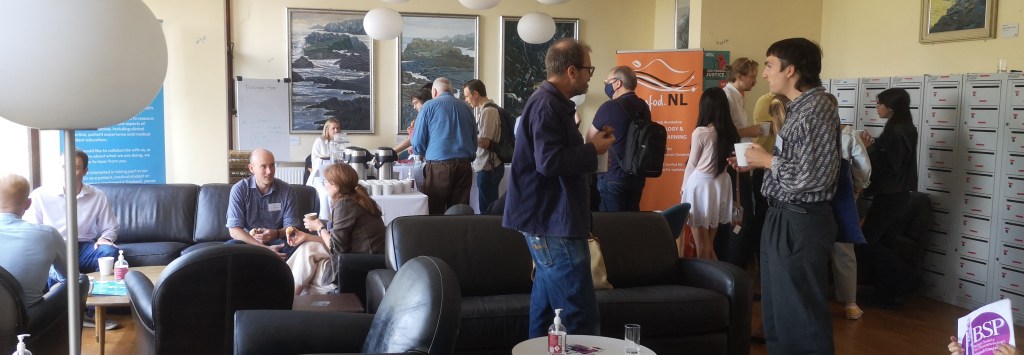
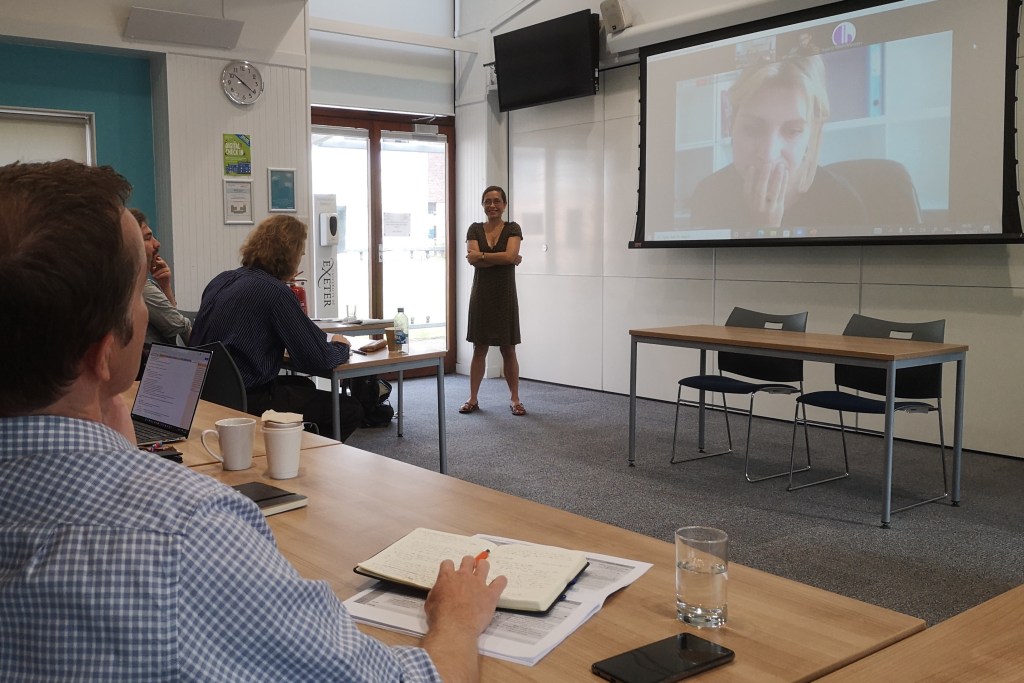
The Senior Common Room at Exeter Queens Building where the hanfod.NL banner had its 2nd outing
Congratulations to the teams (BSP & Exeter) on a brilliant event! It was a great privilege and pleasure to attend in-person after sampling online in 2020. I was a bit embarrassed to be thanked for chairing the methods session yesterday, when the hosts were all over it. I merely did a bit of sentence strangling, to allow a couple more questioners their say. Even that was made far easier by Zoe Waters who anchored the session.
Exeter Quay
I went to Exeter with few expectations but a fair bit of dread, and kept reminding myself of why I was going: literally fly the flag for hanfod.NL But fainter hopes were more than realised. It was so helpful to be exposed to a range of current scholars deploying a wide breadth of phenomenological ideas in a variety of ways. There were certainly opportunities to break the brain on thoroughgoing philosophy but also a range of ‘engaged’ papers. Even the read-out and zoom-streamed philosophy papers were more accessible at a conference. In her NLC2020 keynote, Prof Lesley Gourlay (sadly not at BSPAC2022 – one day Lesley 😉 raised the eventedness of lectures as special, and, if we aim for everything to be recorded, because we can, we risk consigning the arguably richer embodied congeniality of events to channel conducive, generative scholarly activity. At Cardiff’s graduation events, I missed the ceremonial announcement that we were ‘having a congregation’. When we concur to devote time and space of our short lives in these ways, it matters and the in-between chatter matters. In one conversation we reflected on how the pressure to raise production values messes with the messiness of exploring ideas, plainly admitting we do not have all the answers cuts against demands to be slick.
Exeter Cathedral in the sun, community café in shade
I don’t claim much depth to my phenomenology yet I was able to keep pace with many of the papers. Without mentioning names, someone in the methods session criticised the inherent reductivism in published frameworks that aim to help novice phenomenologists. Of course, such frameworks can be helpful, and this is especially the case where a ‘loose coupling’ leaves the researcher with guiding stars, rather than a prescriptive routine that squeezes out opportunities for developing reflexivity. Students can be in too much of a rush and instrumentalise the method instead of understanding it and their place in it. Phenomenology is beyond understanding for the best of us anyway… And yet, Max van Manen’s phenomenology of practice, not mentioned this week, does, for me, hit a sweet spot of impelling one to push for deeper grounding into the heart of phenomenology while laying out the parts in sufficient detail to avoid getting completely lost. Max was busy on a new edition of his 2014 book, so we were thrilled that his son, Michael van Manen, who did get a mention this week, agreed to present for us on the 14th (see previous blog post). I was not there to present a paper, at least I was able to encourage a few scholars even newer to phenomenology than I am: I was able to point to the place of oft dreaded canonical writers, drawing from Max van Manen’s framing them as ‘insight cultivators’. It’s not how much you cover, but how inspiring a sentence can be for analysis. With that in mind, I’ve set off on a 2-page per day odyssey with Merleau-Ponty’s Phenomenology of Perception. I’ve always believed in the importance of reading beyond oneself but MP seems harder than Gadamer! I will find my feet again in the Preface, which is more than enough to stretch the mind.
Statue of Floella Benjamin, famed Chancellor (not least for hugging graduating students rather than doffing or handshaking!
Back to the conference, another draw for me, and hanfod.NL interests, was that Dr Lucy Osler was presenting. One of her aims was to seek another way out of the dichotomy between technological optimism/pessimism and online/in-person sociality. A brilliant talk, there were clear links with the recent symposium papers and great potential for cultivation of insight!
Lucy Osler beaming in from Copenhagen on the first day of her lectureship at Cardiff! Just outside is the well greased elbow of Matt Barnard, indefatigable in his support of the event – big thanks to him!
We are thrilled to announce a webinar featuring Michael van Manen (University of Alberta profile page). Endowed Chair in Health Ethics, Michael is the Director of the John Dossetor Health Ethics Centre, and an Associate Professor in the Department of Paediatrics.
Michael van Manen
In just over three weeks time, on 14th September, Michael has very kindly agreed to rise early to help us understand phenomenology of practice from his perspective as a neonatologist (see webinar abstract below). We have scheduled 60 minutes for the presentation, leaving 30 more for questions and discussion.
A link to Michael’s recent discussion of Medical Ethics is offered below.
Webinar Abstract: Phenomenology of Practice: Ethics, Phenomenology, Value What does it mean to do phenomenology directly on the phenomena that we live?
What distinguishes phenomenology as a method compared to other human science traditions?
How may phenomenology offer relevance and value to professional practitioners such as teachers, nurses, doctors, social workers, or other caring professions?
Phenomenology does not have to be an impenetrable philosophy but instead may be realized as a method to sensitively explore and explicate everyday human experiences.
Such understandings offer insights into the everyday ethics implicit in the practices of practitioners.
In this talk, I will discuss the tradition of phenomenology of practice, and the intersections of ethics, phenomenology, value, and technology at the hand of several health research projects. I hope to show the value of phenomenology for practice and also the value of practice for phenomenology.
We do hope you will join us on the day. Please email info@hanfod.nl for the Zoom joining link or download this ics calendar file. We hope to record the session so you can catch up if you are unable to attend online.
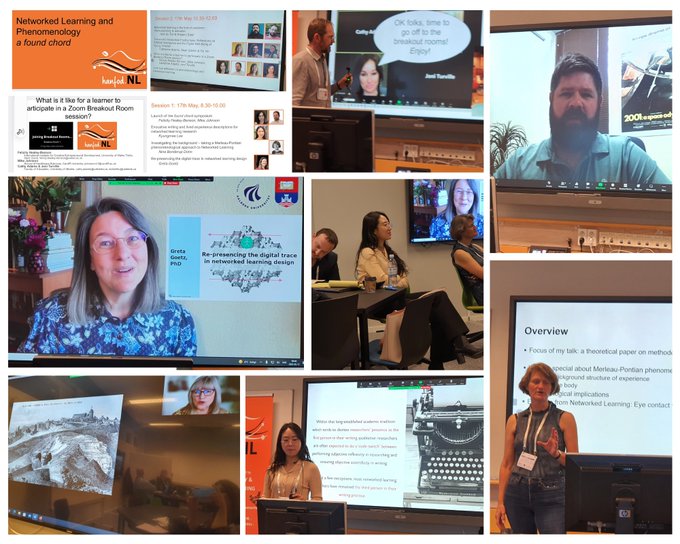
I remember well enjoying the 2020 conference from Cardiff and have fond memories of really important happenings, including hanfod.NL that arose from it. However, to be back in-person at Sundsvall was profoundly wonderful. I have some photos on flickr and Felicity composed brilliant montages, one of which is featured here but see the others and her brief write-up on her EmergentThinkers blog.
We are incredibly grateful to our fabulous partners especially because our combined work strengthened the conference and lay down a marker for phenomenology at it.
Montage from our ‘Found Chord’ symposium at NLC2022 (cc FH-B)
We were planning a workshop to tide us over between the fact that we couldnt run with more than 90 minutes at the conference – it really needs longer than that! There has been little uptake and so we are planning to pitch the workshop off into next year. Meantime, we have some exciting work and plans for the slots, the Wednesday in particular with a special guest speaker webinar.
Just a quick post to invite anyone who would like to participate in another online-only phenomenology of practice workshop with us later in September, please email info@hanfod.NL to let us know and we can send you further details. As you might appreciate, there is a LOT of catching up to do after being away at the Networked Learning Conference so I may come back to doll this post up a bit when I get a chance.
These sessions are only introductory and yet the focus is so deep, many people, us included, appreciate returning time and again to the same matters so feel free to do so. Apologies to those who will struggle to make this timing because of time-zones. We have not forgotten you! We just needed to get something in the diary for after the conference where we could only do ‘Session 1’, see below:
Doing phenomenological research: human science (e.g. gathering material through interviewing, observation) and philosophical methods (e.g., the reduction)
EXERCISE: writing lived experience descriptions
Reference
Adams, C., & van Manen, M. A. (2017). Teaching phenomenological research and writing. Qualitative Health Research, 27(6), 780-791. doi:10.1177/1049732317698960
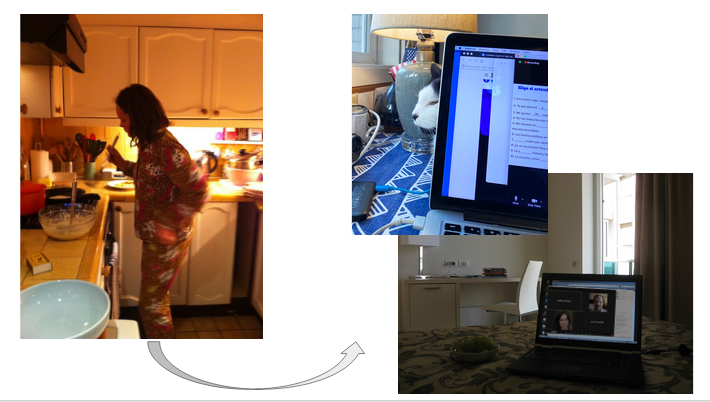
Wonderfully, some of us are able to travel to an international conference to celebrate and enjoy this event, after an in-person hiatus of four years for regular NLC delegates. I am writing this as the coach takes me from Wales across England to Heathrow. Very sadly I am mindful that Professor Cathy Adams is unable to attend for unavoidable personal reasons. Her in-person presence will be sorely missed and we wish her well (hugs will be all the tighter next time, DV). This throws down the baton for Felicity and myself to make a success of the workshop on Tuesday afternoon, based heavily upon Cathy’s content and approach. For this 90-minute workshop, we are running in-person only (but offering another online only workshop 12 & 14 September 14.00-17.30 (UK time). The organisers sensibly opted for a hybrid of online and in-person attendance. Whatever the merits and compromises of trying to cater for both, the prospect of having to swing to online only again was very real and we would just have to make it work again. Life has become even more uncertain over the last months, and these very days, our conference host nation is deciding whether it will join NATO, something Russia may not take without disruptive retaliation… something every one of us travelling to Sweden has a heightened awareness of. Why travel when you could ‘videoconference’ is an obvious question that some will ask. Below are two slides from our zoom breakout room presentation to help explain. When I played spot-the-difference with these images with students yesterday, although there were smirks at those in the picture who were slumbering (a classic trope used by those who denounce lectures), their other responses chimed with Prof Lesley Gourley’s superb keynote at NLC2020, and the eventedness of this kind of gathering that was so much richer than what is sometimes mocked as an embarrassing attempt at anachronistic, domesticating knowledge transfer into passive recipient digital natives with hybrid learning styles and minimal attention spans.
In-person education (large class to group-working)Online education (large class to group-working)
How many daisies does it take to make a chain? Now we have two!
I recorded this ‘daisy’ as a prelude to our symposium, ‘Networked learning and phenomenology: a found chord’, and note it is published one month before the start of the 13th International Conference on Networked Learning.
Mike Johnson, speaking without notes, about speaking.
I promised that I would follow Greta’s recording, however, it was always, following the daisy chain metaphor, going to involve some violence to what she did, in order to ‘attach’ this recording to her’s. Indeed, I felt torn between Greta’s brilliant scholarship and erudition, that she read it out, [even more terrifying for me now is that Greta later informed me that she wasn’t reciting!!!! I am scrabbling at the foot of Greta’s Eiger-like scholarship, but anyway…] and something that Gadamer (2014) discusses concerning recitation:
Reciting is the opposite of speaking. When we recite, we already know what is coming, and the possible advantage of a sudden inspiration is precluded.
(Gadamer 2014, p552, in the Afterword)
Thus, for my recording, I felt compelled to try and speak without notes. Just 10 minutes after all… Should be easy! No. Apart from exposing the huge gulf between my ‘beginner’ level scholarship in phenomenology and Greta’s astonishing expertise, and the danger of my sliding into waffle, part of the dread of this recording is my own reluctance to foist more verbiage into an already cluttered world. You might be able to sense the awkwardness in my voice. So I don’t have a verbatim transcript for you but will add the following…
I wished to link this post with Steve Fuller‘s 2014 argument in his keynote, ‘The Lecture 2.0’, at NLC2014 (watch on YouTube and hear Nina in the questions at the end!), that brand-conscious/savvy Universities ought to only put out content by the ‘best’ performers. That was a provocation, and sat alongside other notable points which I take up here:
The lecture is not mainly about the faithful conveyance of knowledge to the next generation. I am bored of the classic medieval image, as can be seen in Wikipedia’s Lecture entry, of some authority figure at the front reading from the only book and students having to write it down to have their own copy of the book. Steve points out that, even then, there was more going on…
The lecture, in the enlightenment sense, is someone exemplifying ‘daring to know’ (after Kant). Academic freedom was a ‘guild right’; the academic is someone whose broad horizon can review much, and make discriminating judgements about the field, and improvise upon that, to ‘riff’ off their notes, to think in public, straying from the script, somewhat like a jazz performance.
The text is still vital, spoken improvisation is on the basis of text.
The student in this setting is training for freedom, in that academic sense of freedom to critique, based on broad/deep scholarship. It is something that maybe only happens formally in viva exams but has many practical and practice-based applications, such as in healthcare within multi-disciplinary team meetings or giving an introduction to a musical performance (I’ve enjoyed Jonathan James (Twitter) doing this for the BBC, here more reciting, here more improvised ).
Merely dealing in orthodoxy within lectures strangles the enlightenment ideal of growing the capacity to think for yourself and compete (and win) an argument. Adept at this, I cant be a ventriloquist – I have to take responsibility, weigh, measure, understand the audience and adapt the speech. I’ve explored this with staff in a seminar around ‘learning to think in public’ – mindmap here.
And then… I must also link these ideas with our Networked Learning Conference Symposium paper is that, in our analysis, a zoom breakout room, a virtual meeting, thins out self-revelation, the truth of the person that we cannot filter so well when in-person. Nothing but in-person speaking obliges ‘unplugged’ students to stand behind their words.
Where do spoken words arise from? Is there not something uncanny in the unscripted spoken word?
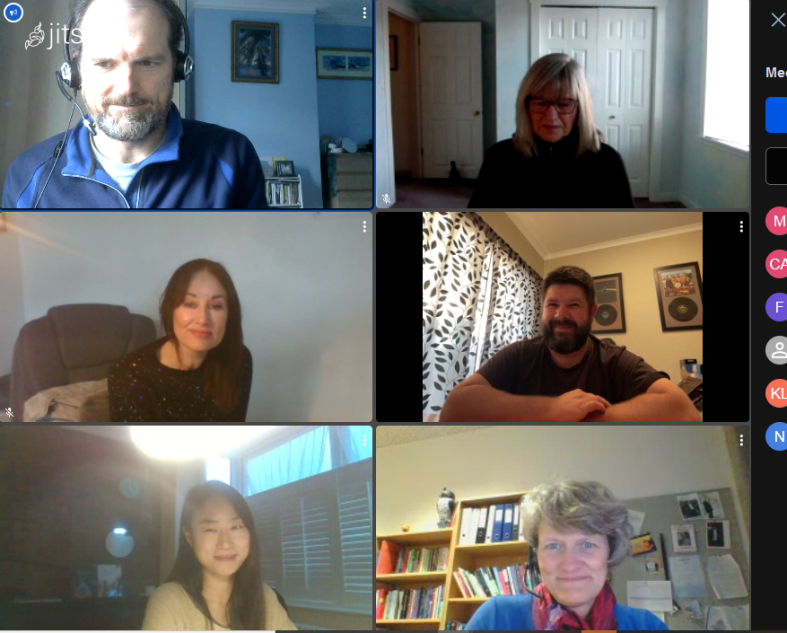
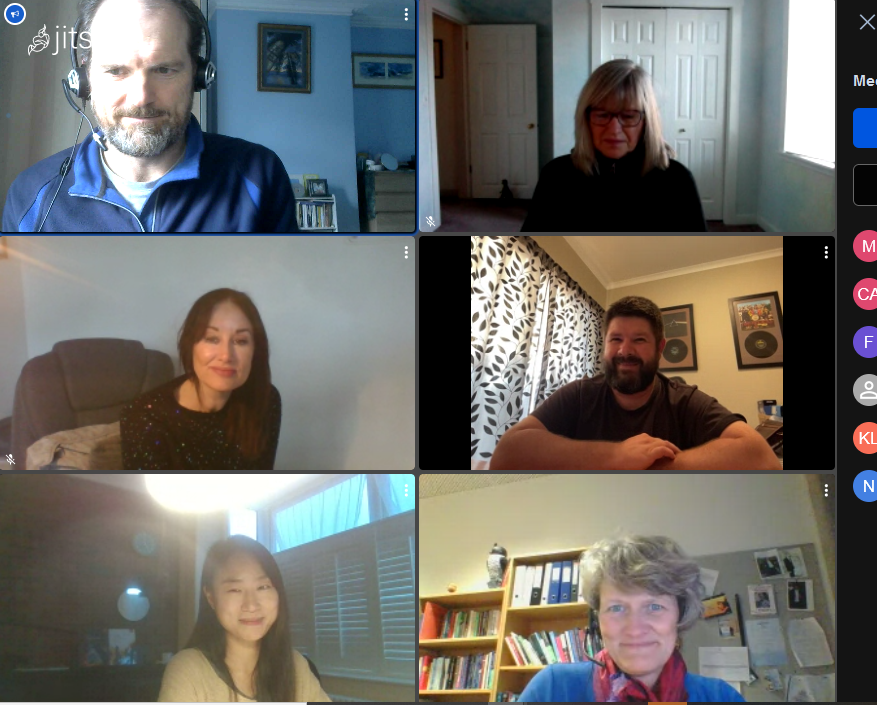
It was a high delight even to meet virtually last Monday, 1st November, to align our objectives and aspirations for a phenomenology and networked learning symposium at the next conference 16-18 May 2022. Felicity and Mike are gently pinching ourselves – we feel like we have a ‘dream team’ of enthusiastic participants who can genuinely carry the hanfod.NL vision of bringing phenomenology into the spotlight within networked learning.
Greta Goertz (2021 PDSE article) – Re-presencing the digital trace in networked learning design
Nina Bonderup Dohn – to discuss Merleu-Ponty’s importance for networked learning research (YouTube video abstract)
Kyungmee Lee (Twitter profile) – exploring what phenomenological ideas can bring to writing ‘thick description’
Felicity, Mike, Cathy Adams and Joni Turville (Twitter profile) bring a phenomenology of practice lens to the student’s experience of Zoom breakout rooms.
Some of the discussion was about having five solid full papers when a symposium is usually four papers, but we have ambitions around filling a double-symposium and developing something substantial to make good use of the time.
We established a few dates: Mike to draft a symposium proposal outline by 26th Nov. 10th Dec to send around full drafts of papers to each other for feedback and responses, and comment on the symposium draft. 3rd Jan 2021 for final full papers, ready for submission as soon as possibly prior to the 7th January target for Networked Learning Conference scientific review.
In sympathy with Greta’s idea of retaining control of the traces we leave within the Internet, we chose to use Jitsi for this meeting and it performed admirably although browser-based (sometimes app-based video-conference tools are more stable). Unfortunately Greta was delayed and so unable to join the group photo-call.
We feel like our 10/11 June workshop was so long ago…. although it is a happy memory. Another small example of overcoming in the face of the pandemic… However, if you had a summer like us, writing was not easy to fit in. A busy life can really desiccate attempts to enter into a phenomenological attitude…
We hope you have managed to relax a little over the ‘holiday’ period – you may be still trying to do so. However, we can’t rest on our laurels for long – we have started to properly look forward to next year’s in-person conference – a very exciting and hopeful prospect, given global events.
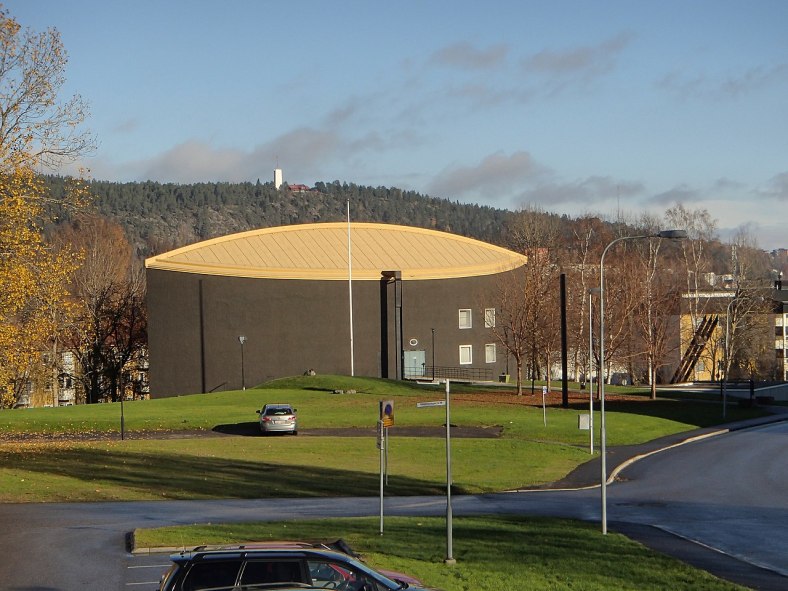
If you have time, take a look at this site which takes an informal look at the host city: http://www.sundsvalltown.se/ Mike really tried to find a land route to Kolding in 2020, and is wondering whether not flying is going to be a realistic option this time without having to immitate Phileas Fogg!
One of hanfod.NL’s aims is to organise a phenomenology and networked learning symposium – the deadline for symposium proposals and full papers is the same – October 8th. We need a clear idea about the viability of a symposium well in advance and so we’re inviting you to join us. Please email info@hanfod.nl with your abstract by 2nd September in order for us to meet online for feedback and review on the 3rd at 2pm (GMT) – you are welcome to join us. We will email the zoom link you if you send us your abstract.
It’s a wrap: you know it was good when people don’t want to leave 🙂 just a small capture of a very full conference but a tardy group pic in the final seconds..
Less than 24 hours ago, we closed down our screens on the successful finale of the hanfod.NL inaugural 2x half day conference. Mike and I would therefore like to take the opportunity to officially thank Professor Cathy Adams for the generous investment of time and energy in the planning and delivery of her outstanding ‘Phenomenology of Practice’ workshop, which is in addition to the contributions as hanfod.NL’s ‘Ffenomenolegydd Preswyl’/’Phenomenologist in Residence‘. The bar has been set high for future events. Thanks also go to Professor Nina Bonderup Dohn, for the lead on our research plans and the wealth of advice on the day-to-day running of hanfod.NL. We must also credit our expert workshop facilitation support, Dr Joni Turville, Dr Begoña Errasti, Dr Iris Yin, and doctoral students, Janine Chesworth and Gillian Lemermeyer.
A big thank you to the Networked Learning Conference Consortium, its co-chairs, Professor Thomas Ryberg and Professor Maarten de Laat, who sponsored and supported our event. The very valuable inputs of NLC’s StineRandrup Nielsen and Morten Kattenhøj must also be recognised.
We were so grateful to have such a wonderful delegate community drawn from many countries, and look forward to continuing to nourish the new relationships forged.
A quote from one of the participants:
It was a pleasure and a privilege to attend the workshop. I enjoyed the clear explanations making such a complex field as phenomenology and the equally complex theoretical constructs it sets forth “easy” to follow. Awesome phenomenological dive. So thought-provoking and evoking!
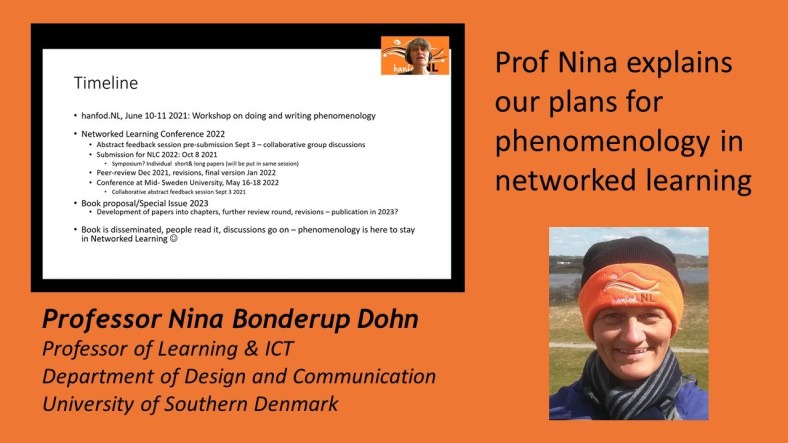
In less than a week we look forward to #hNL21. Here, Professor Nina Bonderup Dohn, University of Southern Denmark, takes us through the research links between hanfod.NL and our event sponsor, the Networked Learning Conference Consortium. Timelines, short & longer term plans, and research & book ambitions.
Exciting times.
Looking forward to seeing all our registered participants next week – those registered already can make use of our communication channels and files access.
In the words of Nina ‘Phenomenology is here to stay in Networked Learning’.
Looking forward – the trail from #hNL21 online to NLC22 in Sweden
Just 3 weeks until #hNL21 and we share a new vlog contribution, this time from Professor Nina Bonderup Dohn, University of Southern Denmark. Nina’s shares a brief introduction to Merleau-Ponty’s phenomenology and discusses focus points in a Merleau-Pontian investigation of networked learning.
It is through our bodies that we are “at grips with the world” (Merleau-Ponty [1945] 1962, 353)
All our vlog contributors are ‘Voices from the River’ – ‘Lleisiau o’r Afon’.
We continue to wish to hear and learn from those who have already taken to phenomenology’s ‘waters’, who can draw us in and along with as we learn with them.
Another week passes, just a month until #hNL21, so we tantalisingly dangle some of the VLOGs housed inside our #hNL21 MS Teams Event Vlog Suite – an opportunity to explore, showcase and celebrate what a phenomenological lens can bring to Networked Learning.
We tease with two vlogs: Associate Professor Jesper Aagaard of Aarhus University, Denmark shares how phenomenology can help us ‘open up’ established research fields and Dr. Joni Turville, University of Alberta, Canada, provides an overview of a phenomenological/post-phenomenological doctoral research project.
We are super excited by the growing VLOG Suite inspired by Heidegger’s analogy – We shall never learn what “is called” swimming … or what it “calls for,” by reading a treatise on swimming. Only the leap into the river tells us what is called swimming’ (Heidegger, 1968:21).
All our vlog contributors are ‘Voices from the River’ – ‘Lleisiau o’r Afon’.
We continue to wish to hear and learn from those who have already taken to phenomenology’s ‘waters’, who can draw us in and along with as we learn with them.
Week 3 of our countdown to hNL21 online (10-11 June) and this week, Mike and I have the joy of sharing our mesmerising conversation with Rikke Toft Nørgård, Associate Professor in Educational Design & Technology, Danish School of Education, Aarhus University, Denmark.
Rikke enthusiastically shares her personal and researcher journey with phenomenology, which began with her doctoral study on gameplay corporeality, discovering bodies in games. Influenced by the work of Merleau-Ponty, and our very own Professor Nina Bonderup Dohn, a beautiful edition, we think, to our ‘Voices from the River/Lleisiau o’r Afon’ hNL21 conference VLOG suite.
Week 2 of our countdown to hNL21 online (10-11 June), and we are thrilled to share a preview of our Phenomenology of Practice workshop led by Professor Cathy Adams of the University of Alberta. Cathy employs Max van Manen’s ‘Phenomenology of Practice’, post-phenomenology, media ecology and related socio-material approaches in her qualitative inquiries of technologies in teaching and learning.
Cathy has made a remarkable contribution to the field, and to hanfod.NL in particular and we are proud, as our Ffenomenolegydd Preswyl/Phenomenologist in Residence’, Cathy kicks stars our very first conference gathering, and sharing an example of one practice example of swimming in phenomenology’s ‘waters’.
After months of persistent phoning and thinking of ways forward, Mike and Felicity met at Barclays Llanelli so that we could arrange to ‘wet sign’ a mandate to share a bank account and secure full access and transparency viz hanfod.NL funds. This paved the way for reclaiming expenses from last year and setting up a GoFundMe page so that we can receive donations. We have set up hanfod.NL as a non-profit and, from the initial vision, the events we organise are free… but that does not mean they are cost-free to us! If you would like to share the burden, or even just encourage us in this work – totally done in our ‘spare time’ (ridiculous phrase when Felicity is home-schooling!) – please do donate something, however small. Thank you!
Supported by the ‘NETWORKED LEARNING CONFERENCE CONSORTIUM‘, we are proud to announce that the 1st Networked Learning & Phenomenology Event (HanfodNL&P2021) will take place in Cardiff in Wales.
Hosted by Dr Mike Johnson & Felicity Healey-Benson, we look forward to welcoming you in 2021.
Join us to help define and shape phenomenology’s place and contribution to networked learning. At Hanfod, (the welsh word for ‘essence’) we hope to seed a vibrant community of phenomenological enquiry within this context.
“Neither phenomenology nor swimming can be learnt in a purely vicarious way. ‘We shall never learn what “is called” swimming … or what it “calls for,” by reading a treatise on swimming. Only the leap into the river tells us what is called swimming’ (Heidegger, 1968, p. 21″. (Quay, 2016, p486).
Event Preview:
Day 1: Thursday 10th June 2021
8.30am (GMT+1): Registration/Welcome
9.15am-4.15pm (GMT+1): Max Van Manen’s ‘Phenomenology of Practice’ Workshop led by Professor Catherine Adams
As one example of phenomenological research, Professor Adams interactive phenomenological research and writing workshop.
7pm (GMT+1) Delegates are invited to join us for a Welsh Banquet at Cardiff Castle. £54 (3-course meal, half a bottle of wine per person (or soft drinks) and traditional and contemporary songs in both English and Welsh).
Day 2: Friday 11th June 2021
9am-10.45am (GMT+1) ‘Voices from the River’ Pecha Kutcha (open to all phenomenological approaches)
In writing groups, delegates will prepare potential contribution to a ‘phenomenology symposium’ at the Thirteenth International Conference on Networked Learning (NLC2022), Sundsvall, Sweden
There are no fees for event attendance but pre-registration to this limited capacity event is required. Day 1 attendance is a prerequisite of day 2.






















 hanfod.NL