Our New Springer Book Available for Pre-Order!

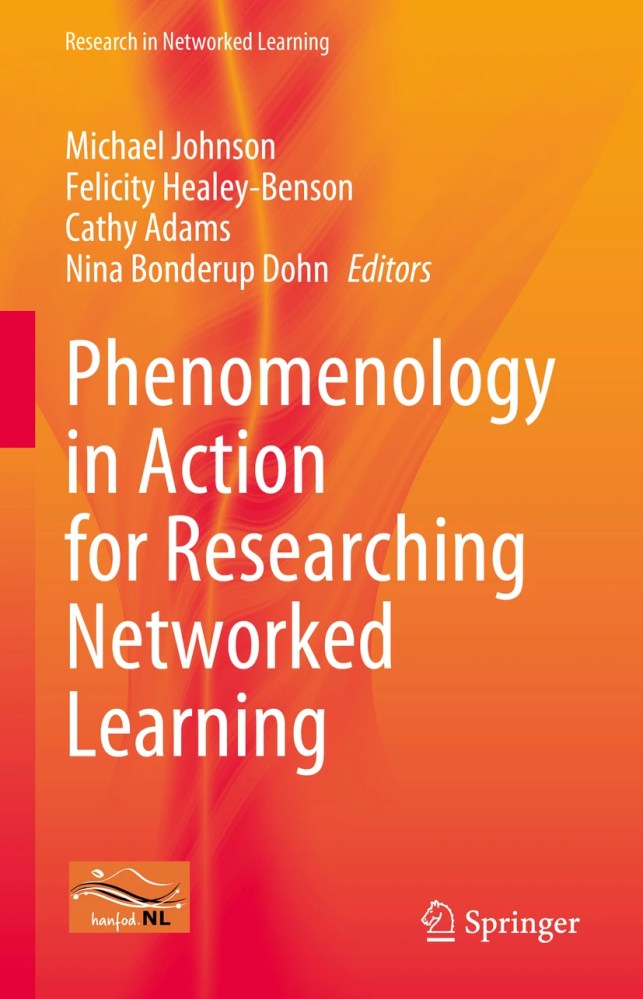
We are excited to announce that our new book is now available for pre-order. Representing a Canadian-Welsh-Danish collaboration, the hanfod.NL team—Dr Mike Johnson, myself, Professor Cathy Adams, and Professor Nina Bonderup Dohn—are thrilled to share the newest edition to the Springer Research in Networked Learning Series. Alongside the opportunity to share our own contributions, our pride and joy clearly extends to a remarkable group of authors who have enriched this publication with their insights. In order of appearance in the book, this includes Dr Lucy Osler (Cardiff University), Associate Professor Kyungmee Lee (Seoul National University), Associate Professor Jean du Toit (North-West University), Associate Professor Gregory Swer (University of KwaZulu-Natal), Dr Joni Turville (Alberta Teachers’ Association), Sean Groten and Yin (Iris) Yin (University of Alberta), Professor Norm Friesen (Boise State University), and Assistant Professor Greta Goetz (Belgrade University).

An official pre-order stage is a significant and joyful milestone for us, and we look forward to sharing further updates.

https://link.springer.com/book/9783031627798#overview

The book aims to provide new insights into the field of Networked Learning, reinvigorate existing debates with new perspectives, and challenge existing understandings in research, design, and practice within the field. We adopt a primarily human-centred approach through phenomenological inquiry, particularly by investigating the interplay between humans and technology to underscore human existence in digital realms.

Felicity, on behalf of Mike, Cathy and Nina.

Phenomenology Café (pilot) in-person 12th July 15.30 Roath Park Lake Café

Arising from our workshop in May, I was delighted to meet Dr Ruan Jones (academia.edu profile, linkedin profile), fairly recently moved to Cardiff Metropolitan University (Cardiff Met) from Leeds Becket. Car trouble frustrated Ruan’s attendance at the workshop, so I was keen to make up for that. Ruan was doubly keen to meet, given his doctorate and because he’d run phenomenology workshops for years at Leeds Becket. 

To cut to the chase, we’re hoping to meet monthly and invite you to join us at the Terra Nova café (googlemaps link) for a Phenomenology Café (pilot) in-person 12th July 15.30 Roath Park Lake Café. If you want to know when we plan to meet next, please email info@hanfod.nl

Scott Memorial in Roath Park

Reflections on Phenomenology in Action: Our Roundtable Experience


The recent roundtable discussion on our forthcoming Springer book Phenomenology in Action for Researching Networked Learning at the 14th International Networked Learning Conference hosted by the University of Malta was an enriching experience. As editors and authors, Mike, Cathy, Nina, and I were humbled by the thoughtful perspectives and valuable insights shared by our esteemed roundtable discussants.

Dr Maria Cutajar of the University of Malta began with comments that underscored the depth and rigour demanded by phenomenological inquiry, while also acknowledging its transformative potential. She emphasised the book’s invitation to think more deeply about our experiences as humans in an increasingly digital world.

Professor Mark Vagle, dialling in from Minnesota, appreciated the book’s nuanced engagement with different phenomenological approaches, highlighting its recognition of phenomenology as plural. He commended the framing questions that guided each section, drawing attention to the emphasis on what phenomenological investigations can reveal and how phenomenology can challenge networked learning.

Professor Lesley Gourlay’s reflections resonated deeply. She spoke about the importance of slowness, stillness, and attending to the ineffable aspects of experience – qualities that phenomenology can help surface. Lesley highlighted the book’s potential to push back against the transhumanist ethos and open up new ways of understanding lived experiences in educational contexts.

Professor Emeritus Vivien Hodgson, a pioneering figure in networked learning, raised thought-provoking questions about the relationship between phenomenology and autoethnography, and the possibilities of integrating creative non-fiction writing techniques. Her insights shed light on how phenomenological approaches could enable richer, more empathetic understandings of lived experiences.

The discussants’ reflections reinforced our belief in the value of phenomenological perspectives for researching networked learning. Their insights have further inspired us to continue exploring the roles, possibilities, and challenges of using phenomenology to understand the complexities of human experiences in digital learning environments.

We are grateful for the engaging discussion and the opportunity to share our work with the networked learning community in Malta. We were also very excited to have some of our contributing authors join us in person – Associate Professor Kyungmee Lee, Seoul National University and Professor Greta Goetz, Belgrade University.

As we move forward, we hope this book will serve as a catalyst for more phenomenological inquiries, deepening our understanding of the lived experiences that shape and are shaped by networked learning practices. We now look forward to the official publication month this year, and to communicate our online event to celebrate with you and our full complement of book contributors. We hope also to share with the Postdigital Science and Education Journal, facilitated by Professor Petar Jandric, Zagreb University.

Felicity, on behalf of Dr Mike Johnson, Professor Cathy Adams, & Professor Nina Bonderup Dohn.


Maria Cutajar PhD is a Senior Lecturer in Arts, Open Communities and Adult Education at the University of Malta.

Mark D. Vagle PhD is a Professor at the University of Minnesota, USA. He has written extensively on phenomenological research in journals such as Qualitative Inquiry

Lesley Gourlay PhD is a Professor of Education, University College London.

Vivien Hodgson PhD is an Emeritus Professor of Networked Management Learning at Lancaster University Management School.
#hNL24 Exploring Lived Experience with Professor Cathy Adams

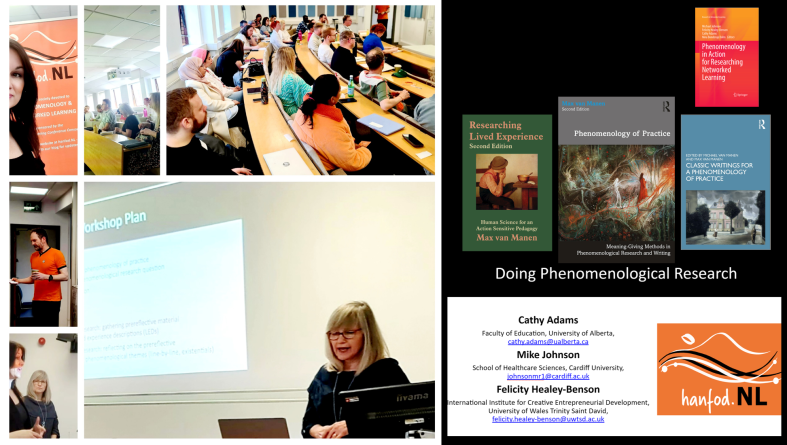
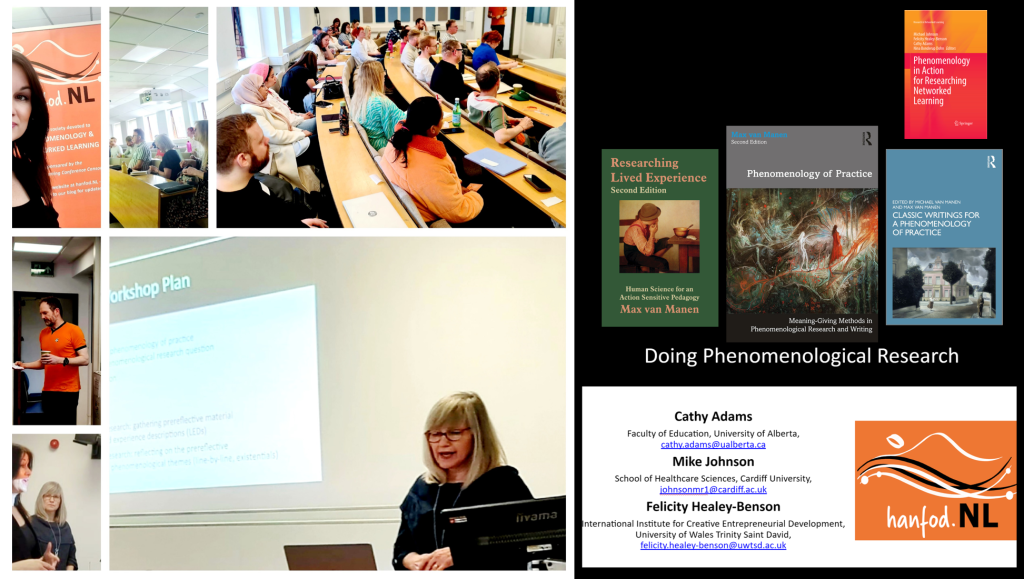
We are delighted to report on Friday’s much-anticipated #hNL24 Phenomenology of Practice workshop in Cardiff with Professor Cathy Adams. It was an enriching and thought-provoking experience for the wide range of participants from various backgrounds and stages of scholarship and professional practice. Enthusiastically sharing her extensive expertise and passion for phenomenological inquiry, Cathy guided the group through the philosophical underpinnings of van Manen’s Phenomenology of Practice, drawing from the works of influential thinkers like Merleau-Ponty, Sartre, and Heidegger. Her nuanced explanations elucidated core phenomenological concepts such as the phenomenological attitude, the phenomenological reduction, and a wondering attentiveness to lived experience.

With clarity and wisdom, Cathy demonstrated phenomenological research techniques like developing phenomenological research questions, gathering rich lived experience descriptions through interviewing, and reflecting on the data to uncover experiential meanings and structures. The interactive activities allowed participants to practice these methods hands-on.

The diverse perspectives and experiences represented by attendees from fields like health sciences, education, philosophy, and more enabled engaging discussions. The day was awash with open exchange and an atmosphere of curiosity and respect for the complexities of human experiences.

Overall, this workshop provided participants with philosophical depth and practical phenomenological methodologies to pursue insightful qualitative inquiries into the meanings of lived experiences across disciplines. Mike and I are so very grateful for the support of the Network Learning Consortium, and for the ongoing contribution of Cathy, hanfod.NL’s Phenomenologist in Residence, who has invested so heartily of her time during her sabbatical period in the UK.

We look forward to continuing our journey together at NLC24 in Malta this week.

Felicity and Mike, handfod.NL

A celebration on Welsh Sands

Mike, Felicity & Cathy – pre-workshop planning

As the sun bathed Swansea Bay in a golden glow today, Mike and I had the pleasure of welcoming the distinguished Professor Cathy Adams to our coastline, setting the stage for tomorrow’s highly anticipated Phenomenology of Practice Workshop in Cardiff.

After months of meticulous planning across various time zones, the opportunity to finally gather in person was nothing short of a phenomenological event in itself. While virtual meetings, email exchanges, and collaborative documents served as our initial platforms, there was an undeniable magic in engaging in face-to-face dialogue in the here and now.

Today’s meeting proved to be immensely fruitful, setting the tone not only for tomorrow but also for the ongoing development of hanfod.NL. The day concluded on a high note with the exciting reveal of the proof of our forthcoming Phenomenology in Action for Researching Networked Learning book’s cover, co-edited with Professor Nina Bonderup Dohn.

We hope you have all had the chance to read our recent pre-workshop communications on email. We are looking forward to seeing you all in the morning!

hanfod.NL

Excitement is brewing at hanfod.NL for a dynamic May!

Kicking Off with a Phenomenology Workshop in Cardiff
hanfod.NL is buzzing with excitement as we gear up for an exhilarating May, starting with our fully booked special event at our Cardiff University location. On the 10th of May, we’re delighted to host Professor Cathy Adams, our esteemed Phenomenologist in Residence, for a half-day workshop on Phenomenology of Practice. This event promises to be an insightful gathering, welcoming scores of participants eager to delve into the depths of phenomenological research.

Crossing Over to Malta for NLC24
Our journey continues as we cross the sea to the sunny shores of Malta for the Networked Learning Conference 2024 (NLC24), 15-17 May. We’re so eager to dive into the conference’s rich themes, including digital futures, environmental sustainability, the transformative impact of AI and emerging technologies, and the vital need for ethical innovation education, as well as pick up on our phenomenological notes. This year’s event is set to challenge our current understandings and inspire new perspectives in the realms of networked learning and digital integration.

Distinguished Keynote Speakers at NLC24
Known for her critical and ethnographic approaches, Professor Felicitas Macgilchrist will explore the cultural politics of educational technology, with a focus on critical, ethnographic, and speculative approaches to the educational landscape, Professor Alexiei Dingli of the University of Malta will address the profound impacts of artificial intelligence in educational settings, and Dr. Jen Ross, co-director of the Centre for Research in Digital Education at the University of Edinburgh, will share insights into the future of digital education.

Interactive Roundtable Discussion
Our own Nina, Cathy, Mike, and I are thrilled to be running an interactive roundtable that introduces our forthcoming ‘Phenomenology in Action for Researching Networked Learning Experiences’ edited collection, an addition to the Springer Book Series on Research in Networked Learning in 2024. We eagerly anticipate engaging with our esteemed discussants, meeting up with many of the book’s contributing authors, and furthering our phenomenological discussions.

A Week of Engaging Academic Exchange:
Throughout the week, the hanfod.NL team will be presenting our own papers. Yet this gathering is more than presentations and formal discussions; it’s a wonderful opportunity to connect, feed, and foster relationships while welcoming new voices into our lively community.

May we see you there and/or look forward to share!

Felicity and Mike

At last, we have a bank account!

Starting anything during the COVID lockdowns was going to be tricky but getting a bank account to manage the hnl21 event finances and such was humanly impossible. And it was not for want of trying. Several abortive trips around South Wales led to the unsatisfactory holding position of sharing one of our private accounts. Thankfully, we are all sorted now with an official ‘treasurer’s account’ with Lloyds so thanks to them for making the process relatively straightfoward, even if their error (about which they were profusely apologetic) led to a 2 month delay. In the scheme of things, that was not a big deal! We had used a gofundme page to take donations towards the hnl21 event but that’s shut due to inactivity. If you would like to send us money, please get in touch by email to info@hanfod.NL and we’ll share the relevant details.

We aim to provide full financial transparency to our ‘parent’ organisation, the Networked Learning Conference Consortium (NLCC) by providing a financial statement at our spring annual general meetings and our Chair, Nina, is also a core member of the business group of the NLCC.

Re-purposing the time 12 & 14 September 2022 14.00-17.30 (BST)

We were planning a workshop to tide us over between the fact that we couldnt run with more than 90 minutes at the conference – it really needs longer than that! There has been little uptake and so we are planning to pitch the workshop off into next year. Meantime, we have some exciting work and plans for the slots, the Wednesday in particular with a special guest speaker webinar.

Just a quick post to invite anyone who would like to participate in another online-only phenomenology of practice workshop with us later in September, please email info@hanfod.NL to let us know and we can send you further details. As you might appreciate, there is a LOT of catching up to do after being away at the Networked Learning Conference so I may come back to doll this post up a bit when I get a chance.

These sessions are only introductory and yet the focus is so deep, many people, us included, appreciate returning time and again to the same matters so feel free to do so. Apologies to those who will struggle to make this timing because of time-zones. We have not forgotten you! We just needed to get something in the diary for after the conference where we could only do ‘Session 1’, see below:

Session 1 – 90 minutes – Online-only 12th September 14.00-17.30 BST

Introduction to phenomenological research (30 mins) and fundamental concepts (30 mins)

EXERCISE: crafting a phenomenological research question (30 mins)

Session 2 – 90 minutes – Online-only 14th September 14.00-17.30 BST

Doing phenomenological research: human science (e.g. gathering material through interviewing, observation) and philosophical methods (e.g., the reduction)

EXERCISE: writing lived experience descriptions

Reference

Adams, C., & van Manen, M. A. (2017). Teaching phenomenological research and writing. Qualitative Health Research, 27(6), 780-791. doi:10.1177/1049732317698960

Mike’s daisy: spoken

man's left hand holding a 2-flower daisy chain above grass with daisies.
How many daisies does it take to make a chain? Now we have two!

I recorded this ‘daisy’ as a prelude to our symposium, ‘Networked learning and phenomenology: a found chord’, and note it is published one month before the start of the 13th International Conference on Networked Learning.

Mike Johnson, speaking without notes, about speaking.

I promised that I would follow Greta’s recording, however, it was always, following the daisy chain metaphor, going to involve some violence to what she did, in order to ‘attach’ this recording to her’s. Indeed, I felt torn between Greta’s brilliant scholarship and erudition, that she read it out, [even more terrifying for me now is that Greta later informed me that she wasn’t reciting!!!! I am scrabbling at the foot of Greta’s Eiger-like scholarship, but anyway…] and something that Gadamer (2014) discusses concerning recitation:

Reciting is the opposite of speaking. When we recite, we already know what is coming, and the possible advantage of a sudden inspiration is precluded.

(Gadamer 2014, p552, in the Afterword)

Thus, for my recording, I felt compelled to try and speak without notes. Just 10 minutes after all… Should be easy! No. Apart from exposing the huge gulf between my ‘beginner’ level scholarship in phenomenology and Greta’s astonishing expertise, and the danger of my sliding into waffle, part of the dread of this recording is my own reluctance to foist more verbiage into an already cluttered world. You might be able to sense the awkwardness in my voice. So I don’t have a verbatim transcript for you but will add the following…

I wished to link this post with Steve Fuller‘s 2014 argument in his keynote, ‘The Lecture 2.0’, at NLC2014 (watch on YouTube and hear Nina in the questions at the end!), that brand-conscious/savvy Universities ought to only put out content by the ‘best’ performers. That was a provocation, and sat alongside other notable points which I take up here:

  • The lecture is not mainly about the faithful conveyance of knowledge to the next generation. I am bored of the classic medieval image, as can be seen in Wikipedia’s Lecture entry, of some authority figure at the front reading from the only book and students having to write it down to have their own copy of the book. Steve points out that, even then, there was more going on…
  • The lecture, in the enlightenment sense, is someone exemplifying ‘daring to know’ (after Kant). Academic freedom was a ‘guild right’; the academic is someone whose broad horizon can review much, and make discriminating judgements about the field, and improvise upon that, to ‘riff’ off their notes, to think in public, straying from the script, somewhat like a jazz performance.
  • The text is still vital, spoken improvisation is on the basis of text.
  • The student in this setting is training for freedom, in that academic sense of freedom to critique, based on broad/deep scholarship. It is something that maybe only happens formally in viva exams but has many practical and practice-based applications, such as in healthcare within multi-disciplinary team meetings or giving an introduction to a musical performance (I’ve enjoyed Jonathan James (Twitter) doing this for the BBC, here more reciting, here more improvised ).
  • Merely dealing in orthodoxy within lectures strangles the enlightenment ideal of growing the capacity to think for yourself and compete (and win) an argument. Adept at this, I cant be a ventriloquist – I have to take responsibility, weigh, measure, understand the audience and adapt the speech. I’ve explored this with staff in a seminar around ‘learning to think in public’ – mindmap here.

And then… I must also link these ideas with our Networked Learning Conference Symposium paper is that, in our analysis, a zoom breakout room, a virtual meeting, thins out self-revelation, the truth of the person that we cannot filter so well when in-person. Nothing but in-person speaking obliges ‘unplugged’ students to stand behind their words.

Where do spoken words arise from? Is there not something uncanny in the unscripted spoken word?

References

Recorded using Audacity. Photo on Flickr.

Introducing daisychain recordings with our first, by Greta

Daisy image CC by Kelbv on Flickr
A single daisy for our first recording in the daisy chain series – image CC Kelbv

To herald the Networked Learning Conference in May, we aim to release short audio reflections, linking with our symposium, and possibly each other’s recordings. Practically, we have in mind those who are curious about exploring networked learning and phenomenology, with the hope of inspiring more people to join in. However, part of the reason is that we just can’t keep quiet for long! – it must be admitted that there is an element of self-indulgent enthusiasm behind this mini-project 🌞

We love metaphors: daisy-chains are delicate, free, and carry a universal, humble beauty. They are often made in a shared between-time, and bestowed as a happy love gift in-person. We hope for you it is the thought that counts. When, as in the COVID-19 pandemic, mitsein (being-with, after Heidegger) may be in short supply, it behoves us, as we can, to humanise interactions and mitigate alienation. We hope hearing our voices will help you to connect more richly with us and the ideas we present. The voice alone is not video, but, as McLuhanesque hot media, may be all the more intriguing for that.

We are beyond delighted that Dr Greta Goetz, University of Belgrade, agreed to start us off. As one might expect, given her 2021 PDSE article, the recording is a singular work of scholarship in its own right, weaving many redolent ideas from her deep engagement with phenomenology. Mike (2008, p330) has styled information technology as ‘a chain of weak links’, which is also a feature of daisy chains, so we invite you to take advantage of the recording while it, the transcript and references, are still available. Honouring Greta’s authorship, the 11 minute recording is to be found on Greta’s site using this link.

References

Goetz, G. (2021). The Odyssey of Pedagogies of Technoscientific Literacies. Postdigital Science and Education, 3(2), 520–545. https://doi.org/10.1007/s42438-020-00188-3

Johnson, M. R. (2008). Investigating & encouraging student nurses’ ICT engagement. In T. T. Kidd & I. Chen (Eds.), Social Information Technology: Connecting Society and Cultural Issues (pp. 313–335). Information Science Reference.

McLuhan, M. (2001). Understanding media: The extensions of man. Routledge.

Symposium Progress

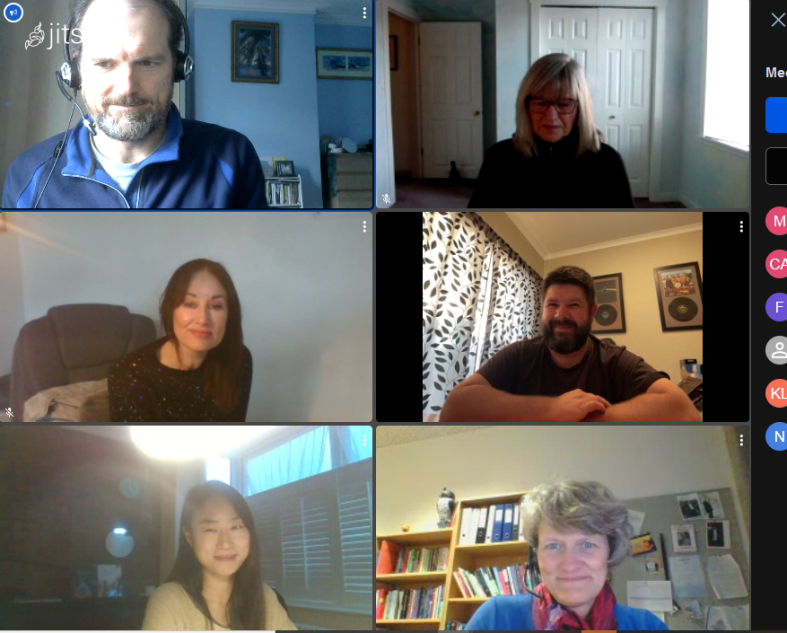
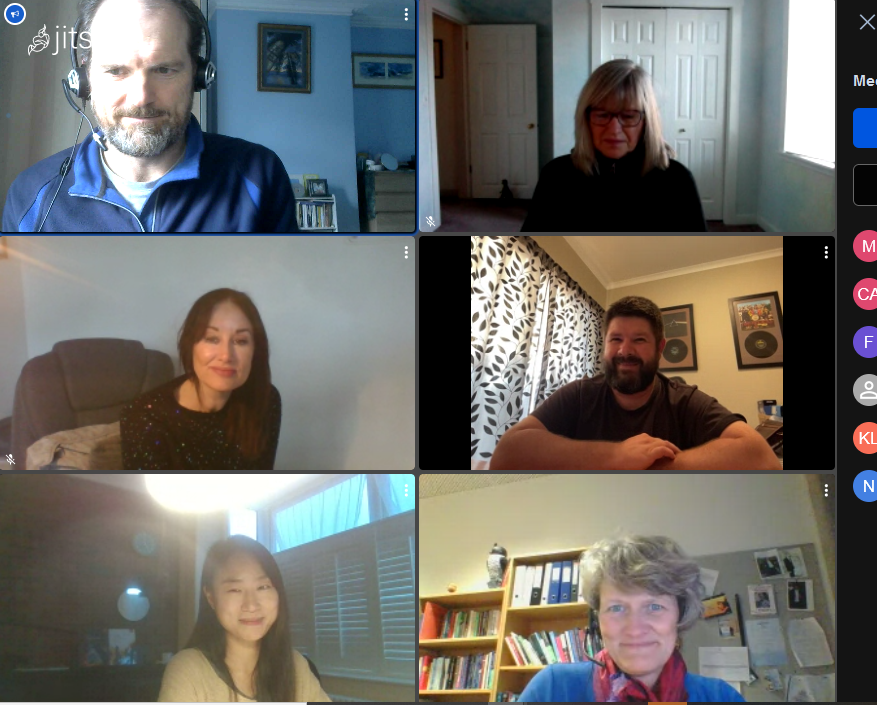
Mike, Cathy, Felicity, Jean, Kyungmee and Nina met using Jitsi (soon afterwards joined by Greta!)
Mike, Cathy, Felicity, Jean, Kyungmee and Nina

It was a high delight even to meet virtually last Monday, 1st November, to align our objectives and aspirations for a phenomenology and networked learning symposium at the next conference 16-18 May 2022. Felicity and Mike are gently pinching ourselves – we feel like we have a ‘dream team’ of enthusiastic participants who can genuinely carry the hanfod.NL vision of bringing phenomenology into the spotlight within networked learning.

  • Greta Goertz (2021 PDSE article) – Re-presencing the digital trace in networked learning design
  • Nina Bonderup Dohn – to discuss Merleu-Ponty’s importance for networked learning research (YouTube video abstract)
  • Kyungmee Lee (Twitter profile) – exploring what phenomenological ideas can bring to writing ‘thick description’
  • Jean du Toit and Gregory Swer – reflect on student reports of alienation and self-awareness while studying in a pandemic. (Meet the authors in this YT video and a recent unrelated article in Teorie vědy)
  • Felicity, Mike, Cathy Adams and Joni Turville (Twitter profile) bring a phenomenology of practice lens to the student’s experience of Zoom breakout rooms.

Some of the discussion was about having five solid full papers when a symposium is usually four papers, but we have ambitions around filling a double-symposium and developing something substantial to make good use of the time.

We established a few dates: Mike to draft a symposium proposal outline by 26th Nov. 10th Dec to send around full drafts of papers to each other for feedback and responses, and comment on the symposium draft. 3rd Jan 2021 for final full papers, ready for submission as soon as possibly prior to the 7th January target for Networked Learning Conference scientific review.

In sympathy with Greta’s idea of retaining control of the traces we leave within the Internet, we chose to use Jitsi for this meeting and it performed admirably although browser-based (sometimes app-based video-conference tools are more stable). Unfortunately Greta was delayed and so unable to join the group photo-call.

Great day! #hNL21 is full!

Looking at it pre-event, we can say that the hanfod.NL initiative has been a success, even though there are many alluring aims still in view, as Nina shared the other day. But today we celebrate a new challenge – being on the brink of oversubscribed for hNL21! The event is a workshop and this means we have to limit numbers to assure quality and feasibility of good facilitation.

Participants’ interests are wonderfully diverse. Some are new to phenomenology, others have taken the course with Cathy in Alberta. Some are young postgrads, others are academics of many years’ good standing. Some can trace a direct link with networked learning research, others are coming more for the methodology refresh with far flung research questions – this can only increase the chances of expanding everyone’s horizons!

A number of participants have so encouraged us with words expressing their delight at finding us, perhaps because they have felt isolated. Mutual encouragement is a big reason of we are here! Someone was moved enough to become our first GoFundMe donor (apart from Felicity and myself!)!

AND our dear friend Stig (University profile page) has provided us with a superb example of ‘insight cultivation’ in a VLOG that touches on Hd’s concept of ‘dwelling’ with reference to networked learning. This is exclusively available to event registrants. The VLOG is entitled, ‘Heidegger, Illich and networks: A short tale of how deictic discourse turned up on my social media.’ You can find out more through Stig’s new book, Philosophers of Technology.

Stig Børsen Hansen. Associate Professor, University of Southern Denmark

Sadly, we are unable to accept further registrations. We had considered over-offering or operating a waiting list but neither of these appeal at our scale. Nevertheless, our mission is ongoing and if you are interested in collaborating with us at the conference (where we hope to run a symposium and a workshop) and beyond, please do get in touch.

The phenomenology trail – hNL21 to NLC22 Sweden

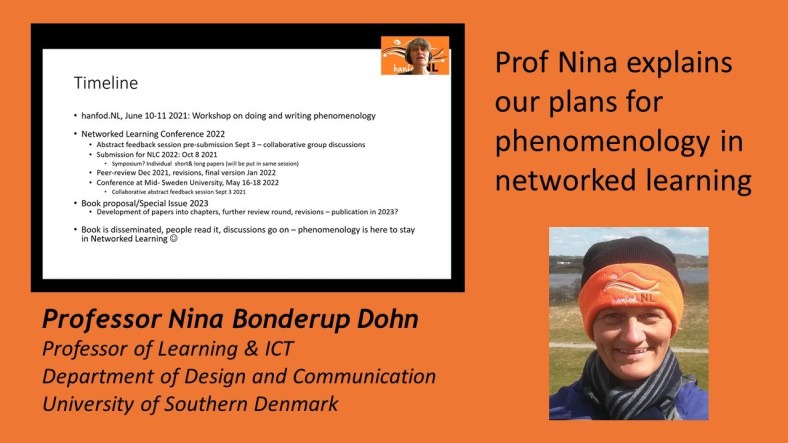
In less than a week we look forward to #hNL21. Here, Professor Nina Bonderup Dohn, University of Southern Denmark, takes us through the research links between hanfod.NL and our event sponsor, the Networked Learning Conference Consortium. Timelines, short & longer term plans, and research & book ambitions.

Exciting times.

Looking forward to seeing all our registered participants next week – those registered already can make use of our communication channels and files access.

In the words of Nina ‘Phenomenology is here to stay in Networked Learning’.

Looking forward – the trail from #hNL21 online to NLC22 in Sweden

Thanks to the generous support of the Networked Learning Conference Consortium and the online nature of the event, the event is free, but pre-registration is mandatory.  See  our Event Registration page for details.

#hNL21 Merleau-Pontian lens vlog

Just 3 weeks until #hNL21 and we share a new vlog contribution, this time from Professor Nina Bonderup Dohn, University of Southern Denmark. Nina’s shares a brief introduction to Merleau-Ponty’s phenomenology and discusses focus points in a Merleau-Pontian investigation of networked learning.

It is through our bodies that we are “at grips with the world” (Merleau-Ponty [1945] 1962, 353)

All our vlog contributors are ‘Voices from the River’ – ‘Lleisiau o’r Afon’.

We continue to wish to hear and learn from those who have already taken to phenomenology’s ‘waters’, who can draw us in and along with as we learn with them.


Thanks to the generous support of the Networked Learning Conference Consortium and the online nature of the event, the event is free, but pre-registration is mandatory.  See  our Event Registration page for details.

#hNL vlog suite spoilers

Another week passes, just a month until #hNL21, so we tantalisingly dangle some of the VLOGs housed inside our #hNL21 MS Teams Event Vlog Suite – an opportunity to explore, showcase and celebrate what a phenomenological lens can bring to Networked Learning.

We tease with two vlogs:
Associate Professor Jesper Aagaard of Aarhus University, Denmark shares how phenomenology can help us ‘open up’ established research fields and
Dr. Joni Turville, University of Alberta, Canada, provides an overview of a phenomenological/post-phenomenological doctoral research project.

We are super excited by the growing VLOG Suite inspired by Heidegger’s analogy – We shall never learn what “is called” swimming … or what it “calls for,” by reading a treatise on swimming. Only the leap into the river tells us what is called swimming’ (Heidegger, 1968:21).

All our vlog contributors are ‘Voices from the River’ – ‘Lleisiau o’r Afon’.

We continue to wish to hear and learn from those who have already taken to phenomenology’s ‘waters’, who can draw us in and along with as we learn with them.


Thanks to the generous support of the Networked Learning Conference Consortium and the online nature of the event, the event is free, but pre-registration is mandatory.  See  our Event Registration page for details.

Countdown to hNL21 begins

We shall never learn what “is called” swimming … or what it “calls for,” by reading a treatise on swimming. Only the leap into the river tells us what is called swimming’ (Heidegger, 1968:21).

It is with much excitement Mike and I kickstart the countdown to the Networked Learning Consortium sponsored node event – hNL21. We have just 8 weeks to go before we join Professor Catherine Adams and Professor Nina Bonderup Dohn for a two-session ‘Max van Manen Phenomenology of Practice’ online workshop.

Over the oncoming weeks we will be sharing some of our video logs (VLOGs) covering our broad theme drawn from Heidegger’s analogy, ‘Voices from the River’ – ‘Lleisiau o’r Afon’ – short captures from people who have already taken to phenomenology’s ‘waters’, who can draw us in and along, as we learn with them. The VLOG suite amounts to our invitation to explore, showcase, and celebrate, what a phenomenological lens can bring to Networked Learning.

Our first VLOG share comes directly from Mike and me, an introduction and discussion on some of the influences and events that led to the birth of hanfod.NL.

Felicity.